A movie and book review blog

Dec 30, 2023

My 2023 list of interesting TV shows on Netflix and Amazon Prime

----------------------------------- NETFLIX SHOWS ---------------------------------------

Bodies turns detective work into a time-traveling comedy, where four sleuths from different time periods in London team up to solve the ultimate whodunit. It satisfies my time traveling craving for the season.

The Fall of the House of Usher : The series is a wild, haunted romp that turns Poe's classic tale into a dysfunctional sitcom-meets-horror mashup.  It's Netflix's way of turning horror into a comedy of errors, making Usher's fall a laugh-out-loud tumble into the absurdly supernatural.

Guns and Gulabs Season 1 is like a crazy curry of '90s nostalgia and gangster drama. The cast is doing their thing, living on their own terms, and you can't help but be part of the ride. Raj and DK deserve a shout-out for the killer screenplay.

Kohrra is not your typical murder mystery. With knock-out performances and a screenplay that packs a punch, it's like peeling back layers of a mystery onion. Punjab's not-so-pretty realities like drugs, forced NRI marriages, and a sprinkle of patriarchy drama form the background of the story. The characters are a hot mess in the best way, fighting personal battles while solving the big mystery.

Beef: Starting from a road rage incident which then leads off to a cascading series of escalating incidents, 'Beef' explores the human condition with a raw, relatable touch. It is a gripping drama about two people living parallel lives in different circumstances. Money, status, and mental health are key topics covered in this series with a unique Asian American cultural twist

MH370 The Plane That DisappearedThe series navigates the complexities surrounding the disappearance of Flight MH370, shedding light on the emotional toll on families, the relentless search efforts, and the lingering questions that resonate globally. It's a poignant blend of investigative journalism and human narratives and expertly steers clear of sensationalism to present a respectful examination of an enduring mystery.

Cunk on Earth A mockumentary gem that simultaneously pokes fun at and revels in the absurdities of our historical narrative. The comedic timing is impeccable, and Cunk's deadpan delivery (Diane Morgan at her comedic best) makes even the most mundane historical tidbits downright hilarious.


-------------------------- AMAZON PRIME SHOWS -----------------------------------

Dahaad Season 1Dahaad is a stellar crime thriller set in the heart of rural Rajasthan, India, exposing the deep-seated biases and injustices ingrained in the region's culture. Sonakshi Sinha shines as Anjali, a determined police officer challenging societal norms. It is based on a true story, the series keeps viewers on the edge, skillfully unveiling the twisted mind of a serial killer.

The Power Season 1 is  a thought-provoking exploration of societal upheaval in a world where women command electric abilities. The writing strikes a balance between drama and the weighty implications of a world transformed. Strap in for a journey where the real shocks aren't just in the superpowers but in the societal currents they unleash. The show adeptly navigates the complexities of power dynamics, instigating a paradigm shift that is both electrifying and deeply reflective.

Wilderness Season 1: Liv and Will, the seemingly golden couple, take their British charm to the Big Apple. The couple's cross-country trip to iron out wrinkles in their relationship turns into a wild rollercoaster of emotions, and suddenly, that dream holiday takes a detour into a living nightmare. 'Wilderness' isn't just a twisted love story; it's a journey into the chaos of relationships, proving that even the best-laid plans can go off the rails. Jenna Coleman is captivating and capitalizes on a well written female lead character, but most of other characters didn't the same kind of attention from the screenwriters.

Vadhandhi : The Fable of Veloni:  Eight captivating episodes centering around the mysterious death of a young woman, setting off a web of deception. SJ Suryah, in the role of Sub Inspector Vivek, skillfully navigates the intricate investigation, revealing layers of lies and deceit. Sanjana, portraying the beautifully haunting Velonie, adds a magnetic charm to the narrative, owning her role effortlessly. Vadandhi may have its flaws, but it's a compelling watch, showcasing the creators' mastery in crafting suspenseful narratives.

Hush Hush Season 1, with its women-centric vibe, shines a spotlight on the talents of Juhi Chawla, Karishma Tanna, Shahana Goswami, Kritika Kamra, Soha Ali Khan and Ayesha Jhulka. The ensemble cast plays a crucial role in weaving a narrative that delves into friendship, secrets, and the highs and lows of contemporary women's experiences. 

When I look at my Amazon Prime picks I realize that these are all series which are either women-centric or has strong lead characters who are women.  Prime also has more quality international content which is not just Korean.

BTW this is how a blog post would look if it was written by generative AI, like this post was :-) Will be switching back to the human mode in the new year. Happy 2024!


Writing Credits for this post : ChatGPT 3.5, the free version.

Share:

Dec 28, 2023

Best Books: My 2023 list

This is one of those customary end of the year lists.  My 'book' reading habit is on life support so I thought it would be a short list I could easily convert into a quick post. I could put the blame of the slow demise of my book reading skills on aging, doom-scrolling internet forums where wisdom (debatable) is delivered through strangers' comments in 8.25 seconds or lesser, or my ADD. Or it could be because the same content delivered by books is now being delivered to the same dopamine centers of the brain the by streaming services?

All the books I read, I consider my best reading of the year. Otherwise I would not have made it to the end as there are more books I gave up in the first chapter or two than the total number of books I read this year.

Here are the four books I read this year and all of them are remarkable because they were able to keep my attention till the very last page. There is also a bonus book - a book you should not read, even if you maybe interested in trains like I am.


Deepti Naval's  A Country Called Childhood : A memoir

Deepti Naval is one of my favorite actors and intellectuals of Indian cinema. A Country Called Childhood is my kind of memoir - it is not about trauma or addiction or tragedy or conquering adversity. It is about the actor's childhood in northern India,  simple, and minimal yet resonant with images of the fifties and sixties India. This is how you should write about your childhood and this is how Indians writing in English should write in English.

Tony Joseph's  Early Indians : The Story of Our Ancestors and Where We Came From

I have written a review of Early Indians here  >> The journalist author Tony Joseph focuses on the group(s) that migrated out of Africa, in three different waves, at three different time periods and became the ancestors of all the people currently inhabiting the Indian sub-continent. It is an extremely interesting and easy to read book based on anthropological, archaeological findings till now and the explosion of DNA evidence and research papers published since 2015 based on these DNA findings

Balachandran Chullikkad's  Chidambara Smarana (Malayalam, memoir)

Balachandran Chullikkad's memoir Chidambara Smarana (pub. 01/2001) reads like a struggling young man's journal entries from 1980-90's India. The rest of my review here.

Andy Weir's  Project Hail Mary 

This is my first Andy Weir. Probably the last too.  I was impressed by The Martian, the movie and thought I should give Project Hail Mary a try before it became a movie. Project Hail Mary is based on a good (not novel) concept with a Marvel-esque hero who is a modest middle school science teacher, written to succeed. This unassuming superhero who wears his cape and underwear inside his spacesuit would have failed in real world without access to Youtube, Google Translate, Google Search, chatGPT and Wikipedia, but for the purposes of this book, all of these sites reside in his head.


The bonus book you should stay away from if you have a liking for Indian non fiction and a sweet spot for trains is The Great Indian Railways: A Cultural Biography by Arup K. Chatterjee.  The author seems to have been too wrapped up in his own 'brilliant' command of English, which was too pedantic, stiff and graceless that I had to give it up after a few pages. Here is Chatterjee starting a paragraph talking about something. It has to be about trains as the book is about them. I think this paragraph may even have something to do with train dining cars.                                                                        

"Second, it perpetuates the reification of labour. Accordingly labour forces of railroad history are meant to be usurped into a memory of personal aristocratic adventures. The motif of culinary details has a very subtle role in accentuating architecture, and those of architecture in establishing an enduring imperial monumentality."

What the heck was that?

This is the problem I have with many Indian writers who write in English. Their tone is pedantic and disconnected. Their prose is full of long winded sentences that lose their meaning on the way while the writers are busy showing off their mastery of Queen's English. They should all read Shashi Tharoor or Suketu Mehta or Deepti Naval. It could be their new year resolution.

Share:

Dec 26, 2023

Oru Vadakkan Veeragatha

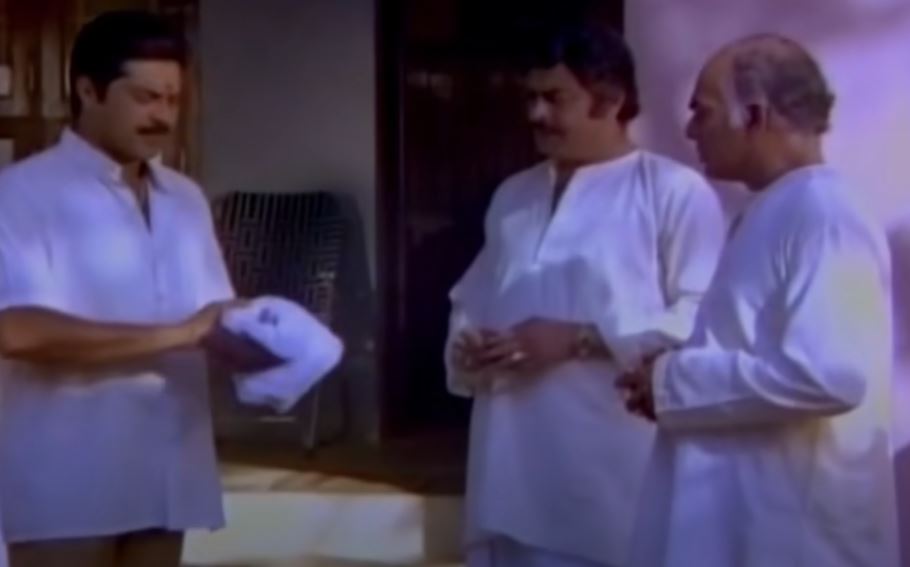
Oru Vadakkan Veeragatha (transl. A Northern Ballad of Valor) is Malayalam literary giant M.T. Vasudevan Nair's retelling of a sub plot from Vadakkan Pattukal (transl. Northern Ballads), directed by Hariharan. Mammootty essays the role of Chandu Chekavar, a negative character in the ballads, who was given new life and a positive spin by the magic of M.T's pen. In 1989, this film (along with Mathilukal) brought Mammotty his first Bharath award - India's national award for the best male actor in a leading role. It also won the best screenplay award at the national level.

Mammootty as Chandu and Madhavi as Unniarcha in Oru Vadakkan Veeragadha (1989)

Malayalam movies nor audience are big on historical dramas, unlike the rest of India or south India. It was an ambitious project for the eighties. Comparing the magnum opus-es of the present day like PS1 or Baahubali, the production design of this eighties movie is almost at the level of a school play. But the screenplay and dialog is beyond compare. The casting and the acting elevates the frames and takes your eyes away from the plastic bead necklaces and cardboard sets.


In addition to Mammootty, Madhavi and Suresh Gopi, Balan K. Nair, Captain Raju, Geetha, Rajalakshmi, V.K. Sreeraman, Sukumari and Sanjay Mitra play other important characters. The soundtrack had some memorable tracks that still maintains their irresistable charm, all these years later.

Madhavi as Unniarcha, Mammootty as Chandu Chekavar and Suresh Gopi as Aromal Chekavar

While Mammootty's Chandu is one of the most unforgettable characters in Malayalam cinema ever, the hero, the villain and the creator of this landmark movie is M.T. Vasudevan Nair. M.T, the author is quite a maestro when it comes to giving under-represented mythical and historical characters their due, by offering the readers/audience a different and nuanced perspective of the character through his work. Before resurrecting and reshaping Chandu Chekavar's traitorous destiny half a millennia after the original ballads (which were based on true life stories of the warriors of north Malabar in the medieval era) were composed, M.T had successfully broken the ground for such character facelifts in his brilliant novel, Randamoozham in 1984.

Randamoozham  (transl. The Second Turnis his retelling of the world of Bhimasena, the second in line of the Pandava clan in Mahabharata who was always pushed to the sidelines by righteous first-born Yudhishtira and the brave and glamorous younger brother Arjuna. It is one of my favorite Malayalam novels ever.

After re-watching Oru Vadakkan Veeragatha as an adult, I realize Chandu's cinematic and literary makeover was at the cost of shifting the blame to other lead characters. Aaromal Chekavar and Unniarcha drew the short straw in M.T's version of the story. I don't remember any of this kind of passing-the-buck happening in Randamoozham?

Aromal, the original hero of the ballad becomes a one-dimensional guy much in contrast to the legendary multi-faceted hero that he was. Instead of urumis and swords he should have been using, under M.T's masterful character correction, he is left with just an axe (to grind, with Chandu.) 

Unniarcha, the fabled warrior princess of Poothuram, is stricken by an acute case of men-writing-women in Malayalam. As the story takes place in the medieval times the focus is less on women's body parts and more on their fickle emotions like deceit, pretense and cunning. These universal characteristics of womenkind are embodied by Unniarcha in the movie and Chandu's dialogs to Archa (written by M.T) are used to rub it in at turning points in the movie to paint her as the fall guy (gal.)

Despite these persona revisions, Oru Vadakkan Veeragatha is a watershed movie for Malayalam movie industry. A native ballad, re-written for screen by one of the masterful talents of Malayalam literature, performed by some of the best actors in their prime against the backdrop of a spectacular soundtrack, no other historical or mythological costume drama has ever come close to it in terms of overall impact. In 1989 it was the longest running Malayalam movie in theaters ever, running for more than one year at Sangham theater, Kozhikode and the biggest blockbuster of the year.


Share:

Oct 8, 2023

Marty (1955)

 Landed on Marty after Amazon Prime suggested I watch Marty next after watching Dead End. It was past midnight and Marty was only 90 minutes long and boasted 4 Oscars from 1955 including the best picture, best director and best actor. Why not? Marty it was, to top off the night.

Marty is the story of Marty Piletti, a mid thirties bachelor butcher, living with his Italian American mother in the Bronx of the fifties. Like mid-thirties bachelors the world-over Marty too is harangued by his mother to marry and bring a girl home as soon as he can. But it is not easy for Marty, played by Ernest Borgnine, he is no Humphrey Bogart at forty five charming the socks of a nineteen year old Lauren Bacall. Marty is a stocky 35-year old butcher who ends up standing on the sidelines at the local dance hall the entire night on any given Saturday.

As luck would have it on one of those Saturdays he meets the female Marty. Betsy Blair (Gene Kelley's first wife) plays Clara who is a high school chemistry teacher, which I believe must have been a quite nerdy occupation for women of that era, who at 29 is also having a hard timing finding a life partner. Blair was one of the actors blacklisted during the McCarthy era. Gene Kelley, her husband had to strong arm the producers and threaten them he would quit the movie he was acting in if they didn't give the role to Blair.


Ernest Borgnine as Marty and Betsy Blair as Clara in Delbert Mann's Marty

This Delbert Mann movie feels like an international movie set in Bronx, where the inter-generational chaos of an Italian American joint family is on full display. Its relatability and down-to-earth script and cast might be why it became the first film ever to win the prestigious Palme d'Or when the award was introduced in 1955.


Share:

Oct 1, 2023

Ozhivukaalam: A review of Bharathan's 1985 film

This was a movie I watched in the theater when it was released, one ozhivukaalam (transl ~ vacation or summer vacation), a rarity in our family.  We usually never went to watch new movies as we had the film club membership which showcased older, classic or indie movies which were deemed worthy of our time and money (= zero money spent, as these were free.) I remember my mother took us to watch Ozhivukaalam, being the reader that she is, my guess is the irresistible combo of Padmarajan's script and Bharathan's direction might have been the draw for her.

Prem Nazir, Sreevidya and Rohini in Ozhivukaalam (1985)

While I did like the idea of Rohini as a modern college girl I saw in the posters of Ozhivukaalam, I was not thrilled at the noticeable absence of Rahman. They were the teen heartthrob pairing those days, like Freddie Prinze Jr. and Sarah Michelle Geller. Not only was Rahman anywhere to be seen, it had Prem Nazir and Sreevidya - an older pair whose chemistry I had no interest in cringe-watching. I don't think I was really impressed after watching it, except that Rohini's role as an independent thinking teen who got a video camera as a gift, I thought, might start a trend of all girls receiving cameras as gifts.

Indian Railways featuring Rohini and Sreevidya

Re-watching it again after almost forty years I realize it is a very modern treatment of a slightly controversial subject - remarriage of a widow. This would definitely be a boring movie for grade school kids. Padmarajan's script holds the movie tight and contemporary. The casting is perfect and the location - Vadakara Sand banks is even more so. In addition to the main cast of Prem Nazir and Sreevidya who play the older couple  planning to get married and Rohini as Sreevidya's fiesty college going teen, Karamana Janardhanan Nair, Jalaja bring up the supporting cast. 

Rohini, Prem Nazir & Sreevidya in Ozhivukalam (1985)

Ozhivukalam is a well written and directed movie except for the twist at the end which anyone can see coming from a mile away, if they have watched a few Indian (any language) movies, which puts the movie squarely back in its era and palatable for the eighties audience.

Share:

Sep 20, 2023

Chidambara Smarana : A review of Balachandran Chullikkad's memoir

Balachandran Chullikkad's memoir Chidambara Smarana (pub. 01/2001) reads like a struggling young man's journal entries from 1980-90's India. Characters played by Mohanlal, Sreenivasan, Mukesh and co. in the late eighties and nineties' Malayalam movies would be Chullikkad if they were devoid of their trademark humor and had overdosed on pathos. The glass seems to be half empty or almost completely empty through Chullikkad's lens/pen whereas Dasan and Vijayan saw it half full, almost abrim with the invisible possibility of more water that may fill and cause an overflow of good fortune at any moment. None of that optimism can be seen in Chidambara Smarana (literal transl~Memory of Chidambaram.)

Balachandran Chullikkad was a fire brand young poet in the eighties and nineties Kerala. Although I was a reader of Malayalam poetry during those days, somehow I seem to have missed most of his poetry. I had read some of his contemporaries like V. Madhusoodanan Nair, Sugatha Kumari and Kureeppuzha Sreekumar but the only poem I remember of Chullikkad is Ghazal. Over the years Ghazal had become a personal meme of sort which we would bring up any time there is a Hindustani singer in the frame, in front of a predominantly Malayali audience, "there goes Ghulam Ali, singing his wail of a ghazal."

A disturbing undercurrent I noticed in Chullikkad's writing is his sterile, almost impaired depiction of women. He might be afflicted with what could be the opposite of Oedipus complex -  utter hate towards mother and motherly figures. According to my armchair psycho analysis conducted a couple of minutes ago with the aid of YouTube, this was probably as a result of his strained relationship with his mother and grand mother during his formative years. He never recovered, and not only that, there is a lack of remorse or wisdom that comes with age, quite unlike what you would naturally expect from a sensitive poetic soul like him. Not all poets are made equal, some are made like James Dean, Balachandran Chullikkad is Malayalam literature's OG rebel without a cause.


Share:

May 27, 2023

Neelavelicham the movie, Bhargavi Nilayam & a question for Aashiq Abu

Neelavelicham (literal translation: 'blue light', poetically liberal translation adopted by the filmmaker, 'blue radiance') is a famous short story by Malayalam literary giant and a renaissance man of simple tastes, Vaikom Muhammad Basheer. It has been made into a movie half a century ago, at the time the director A. Vincent had titled it "Bhargavi Nilayam", the name of the fictional abode of the ghost lady in the short story. Bhargavi Nilayam has long since become synonymous in the Malayalam culture and lexicon as any building that has been taken over by ghostly presence(s) overstaying their visa status on the earth. About a decade ago I wrote a one paragraph review of the movie in this blog, when what I really wanted to talk about was that movie's hero - Madhu.


Not sure what Aashiq Abu, the director of this new take on the short story wanted to talk about by taking on the enormous risk of remaking an old blockbuster movie and a much-read short story of a beloved author. Everyone is going to have opinions and any fault is going to be magnified manifold and scrutinized to death. Maybe the man just loves taking risks in pursuit of honing his craft. This is what I like to conclude because I have always looked forward to Aashiq Abu's directorial outings and love to watch the technical improvement happening with each new release. Neelavelicham is no different in the technical department - production design, cinematography, casting, script are all excellent.

Tovino Thomas as Vaikom Muhammad Basheer has been styled and executed better than the suave Madhu who when you think about it reflected none of the life experience as a hotel manager, shepherd, sports goods agent, activist, watchman, fruit seller (to name a few) multi-faceted background of the real author. Roshan Matthews and Rima Kallingal's characters as the lead romantic pair is on par with Prem Nazir and Vijaya Nirmala's characters from the 1964 film and have been scripted to be digested by a contemporary audience. 


The production design recreating the era of the newly independent India where the story is set is probably one of the best I have seen recently in any Indian movie and is a welcome relief compared to the staged sets of the 1964 version. Not to blame any of these on the 1964 movie which was made at an age and a time when actors lived and emoted in a different plane than ordinary people and that sort of disconnect and staging was the norm. It is most evident nowhere else than the villain character Nanukuttan essayed in the 1964 movie by the stalwart actor P.J. Antony in blackface makeup. In the 2023 version it is Shine Tom Chacko, without any black paint on his face, but with the essential villainy captured through his acting and the script. The director has taken the same care to make necessary changes to make it a suitable for a contemporary audience, trimming down the length and dialogs.

The only question I have for Aashiq Abu is, if this was your take of Basheer's story Neelavelicham why did you take on the role of an editor or a quality analyst instead of being the ingenious director I have credited you to be? Neelavelicham (2023) is a scene by scene, quality improved copy of the 1964 Bhargavi Nilayam. You, Aashiq Abu, who has always given a relatable perspective on life through movies (especially to Millennial and Gen Z audience) whether it be Salt n Pepper or 22 F Kottayam or Da Thadiya or Idukki Gold or Mayanadhi, what stopped you doing from giving us a fresh take on Neelavelicham, instead of making a low-effort photocopy, albeit technically brilliant?


Share:

Apr 25, 2023

Early Indians by Tony Joseph : A book review

The oldest scientifically dated remains of a modern human aka HOMO SAPIEN - which is you, me and every human being currently alive on this planet, is 300,000 years old, found in Jebel Irhoud in Morocco. When you consider the enormity and scale of that timeline you will realize the most popular member of the religious trinity group - J.C and the original fashionista Cleopatra left the stage just a heartbeat ago. Only a mere 2000 years have passed since they handed over the mic to Jay Z and Beyoncé.

Our kind, Homo Sapiens (this is important since there were several other kinds of human species coexisting 100 - 200,000+ years with Sapiens like Homo Erectus, Neanderthals and Denisovans), ventured out of Africa to Asia first and Europe later between 40 - 60,000 years ago. Americas being the last continent to be settled by the journeying biped Sapiens 16,000 years ago.

All people outside of Africa in the world today are descended from a single African woman of L3 haplogroup. In a similar vein all people outside of Africa (i.e. modern human = Home Sapiens) are descended from a single man of CT haplogroup. In short our differences are only skin deep and race is a powerful illusion that everyone of us has bought into.

The journalist author Tony Joseph focuses on the group(s) that migrated out of Africa, in three different waves, at three different time periods and became the ancestors of all the people currently inhabiting the Indian sub-continent. It is an extremely interesting and easy to read book based on anthropological, archaeological findings till now and the explosion of DNA evidence and research papers published since 2015 based on these DNA findings. 

What Early Indians is not is, it is not an international pop-sci best seller like the Sapiens with its far-fetched and reductionist claims which made Sapiens the non-fiction counterpart of Paulo Coelho's The Alchemist, in my mind. Hot garbage, Early Indians is not. If you have roots in the Indian Subcontinent and if your attention span can hold for about 270+ pages, it does not have to be in one sitting, this is a book worth reading.

Share:

Mar 6, 2023

Mukundan Unni Associates : Where Karma Goes to Get Killed

In the absence of the specter of sin employed by monotheistic religions to keep their followers all sheep-ly and righteous, Indian religions and philosophy, use Karma to enforce lane discipline on the morality highway. Mukundan Unni Associates (MUA) is the first anti-karmic Malayalam or Indian movie I've ever watched. 

Abhinav Sundar Naik's directorial debut is an unapologetic feature film, out to prove Hindu and (subsequent) Buddhist philosophy's first law of universal causation and effect has no street cred in the twenty first century world. The movie opens with this text, "human beings are mostly grey, but in some cases they are just black." If you are into armchair psychoanalysis as I am and have read aplenty about serial killers sporting the harmless guy vibe or have watched American Psycho or Nightcrawler, this one line should give you some idea how the protagonist of this movie is going to turn out, with a flat, dark, un-empathetic psycho/sociopathic edge, prone to plenty of mental monologues. The monologue voice-overs of the main character written by the director kicks a$s. It does not come as a surprise that during a low period in his life Naik is said to have watched Dan Gilroy's Nightcrawler multiple times, MUA is brimming with this dark inspiration.

Mukundan Unni, the lead of the movie, is a lawyer who prefers to wear the impeccable white on white 'uniform' worn by lawyers in India, but has a mind which is the darkest shade of black, just like a lawyers' robe. Vineeth Sreenivasan, who has essayed the title role is growing into these sociopath roles (LOL.) Will Mukundan Unni stand the test of time and have the staying power of Sreenivasan Sr.'s Thalathil Dinesan? From Ravi Padmanabhan in Thannermathan Dinangal to Mukundan Unni, Vineeth has been delivering some killer performances essaying the unrecognizable-psychopath-next-door.  Other actors like Suraj Venjaramood, Jagadeesh, Sudhi Koppa, Tanvi Ram have meaty roles although their screen time is nowhere near that of the lead. 

The message of the movie is there is no message. But if you are one of those viewers who like message(s)-in-a-movie, try these - karma is still a b@#ch, but s/he is on vacation, there is only truth(reality) no consequences and feel free to engage in haymaking during daytime. 


Share:

Feb 26, 2023

12 Angry Men

The Sixth Amendment to the U.S.Constitution guarantees the right to trial by a jury. In case of a criminal trial, the jury consists of 12 people, citizens drawn from all walks of life, who decide the verdict of the case. 12 Angry Men is Sidney Lumet's first directorial venture, shot entirely in a New York city jury room where 12 middle-class white men decide on the fate of young teen (maybe Puerto-Rican, maybe Italian, definitely someone from the wrong side of tracks) who is charged with murdering his father.

The movie while it garnered 3 Oscar nominations was not a commercial hit at the time.  Over the years it has gained quite a following and is often taught in high school business law classes, film schools and Youtube videos purporting to teach the art of persuasion.

I've always wondered how juries reach unanimous decisions, considering most of the jury members are ordinary people whose closest brush with law might have been when they walked in front of a TV set playing Law and Order. More importantly the State has to prove beyond reasonable doubt that the accused is either guilty or innocent and all the members of the jury have to have be on the same plate. Beyond a reasonable doubt” is the universal standard of proof for criminal prosecutions in state and federal courts in the United StatesO. J. Simpson would definitely thank the Due Process Clause of the 14th Amendment which requires the State to prove that every element of a charged criminal offense is beyond reasonable doubt.

In 12 Angry Men, at the start of the jury deliberation there are 11 jury members believing the accused is guilty and one person and the 12th man, Juror #8 (Henry Fonda) is not convinced the accused is guilty. There goes the unanimous verdict and starts the 1.5 hr real-time deliberation which forms the 96 minutes of movie show time.

The tight script by Reginald Rose is supported by  phenomenal actors like Lee J. Cobb, Henry Fonda, E. G. Marshall and others.  It is a film that is totally reliant on dialog and performance and does a great job on both. As a film that is shown for the students at film schools, law schools, sociology and psychology departments,  there is something for everyone whether it is camera and writing techniques or a study in confirmation bias or methods of persuasion.


Share:

Feb 12, 2023

Flowers For Algernon : Bouquets or Brickbats?

Flowers for Algernon, the Nebula award winning 1959 sci-fi novel by Daniel Keyes is a crowd favorite for the last half century. There were several reasons I should not have tried reading it, starting from my inability to read fiction as years progress being the main one. It did not help that the book belonged to category of 'scientific fiction' and was not written by a couple of SF writers that I could understand, namely Douglas Adams or Philip K. Dick. Nevertheless none of these stopped me from attempting to read this book, as the whole internet is ga-ga about Flowers for Algernon, I caught a case of FOMO. 

Little did I know this book is the American cousin of Paulo Coelho's The Alchemist, another novel that has been anchoring the book shelves around the world with un-shakeable gravitas and giving their readers self importance and reading participation trophies since it came out in 1993. 

While The Alchemist has a global following like soccer, Flowers for Algernon is very American like 'American football' (the one that uses hands to play.) Keyes went as far back as Mark Twain to adopt Huckleberry Finn's lingo, which had made reading Huckleberry Finn a torture for a non-native English speaker like me, who had to read aloud the mis-spelled words to understand what Huck Finn was saying. It is the same with Charlie, the protagonist in Flowers for Algernon. The first several chapters, the one dimensional Charlie jots in his journal is torture for speed readers, grammar-nazis, spell-checkers and me. 

The novel also has a distinct fifties-sixties anti-feminist vibe to it, like the Catcher in the Rye or One  Flew Over the Cuckoo's Nest. A few chapters in, Charlie is seen progressing through his Holden Caulfield phase - a moody, self-absorbed, misogynistic male. There are archetypal female characters propping Charlie up as he goes up and down the slippery IQ slope.  It was probably an edgy read in the sixties and seventies. It reads very dated as in outdated and uni-dimensional now. I was expecting a good cry at the end as this was supposedly the reaction most readers had in the end, after being profoundly moved by the plight of Charlie. I almost cried over the time I wasted reading Daniel Keyes essential soft-core reading for sixties dudes.


Share:

Jan 31, 2023

Pakalkkinavu

Tales of philandering playboys and gullible girls 'destroyed' by these men have provided fodder to many an Indian movie. Pakalkkinavu, (def:daydream)  is a 1966 Malayalam film penned by M. T.  Vasudevan Nair and directed by S.S.Rajan based on this general theme.

Nellikode Bhaskaran & Sathyan in Sathyan's mid-century modern apartment
Other than M.T's characteristic protagonist, a young man from a tharavad in Valluvanadu, the story, the setting and the dialog are very modern compared to other Malayalam films from the sixties. This is the earliest Malayalam movie that I have seen/heard the word "cool" being used by the lead actor in the way we use it now, as a slang term meaning awesome.

Even the young man, played by a young looking 54 year old Sathyan is not the typical hero you see in M.T's stories. In fact both male characters in the movie, Sathyan's Babu and Nellikode Bhaskaran's Chandran are atypical of the roles each actor used to play during their usual outings. Nellikode Bhaskaran has a meaty role in the movie, a far cry from the side roles I am used to seeing him in.

Sathyan on his motorcycle, Sharada and Bhaskaran looks on
The movie starts with a motorcycle ride through the city of Bangalore where Babu is seen establishing his character as the rich scion who matches women on his pillion with his outfit of the day. It was an eye-opener for me that even back in the sixties, Bangalore was Keralites' idealized city where girls went to go wild and men were all dashing and debonair. In this city of daydreams, Babu is seen living in a hotel suite decorated with tasteful pieces of mid-century modern furniture. He drinks beer for water and plays savior to jobless youth like Chandran when he feels like it, with only one condition - no one is supposed to give him life advice. Keeping your mouth shut vs homelessness, that is an easy choice for Chandran.

A very young Sharada as Malathi makes appearance as Chandran's acquaintance. But the audience and Babu knows, try all he might Chandran is not going to get the girl. The girls usually have a incomprehensible fondness for dudes on motorcycles and Malathi turns out no different in the end.

Sharada & Sathyan - 30+ years age difference separates the stars often paired togehter

The second half of the movie shifts back to Kerala from Bangalore and in Malathi's place we have Vasanthi as Shaari, Malathi's younger sister. While it is melodramatic at some places as was the trend of the times, the treatment of the movie, including the ending is contemporary.


Share:

Dec 30, 2022

One Hundred Years with The Problem of China

One hundred years ago, Bertrand Russell identified the potential, the promise and the puzzle that is China in his book "The Problem of China." Russell is a multi-dimensional personality who has started to interest me during my recent expeditions in philosophy. I picked 'The Problem of China', on a whim to understand Russell - the philosopher thinker, born to an aristocratic English family, curious what he had read in the tea leaves about the slumbering dragon China was at the time. 

Bertrand Russell spent 10 months in China starting in the fall of 1920 to July 1921 teaching philosophy at Peking University. He arrived in China towards the end of the May Fourth movement. Chinese intellectuals were looking at Russell and other western philosophers like John Dewey to propose solutions for 'fixing' China. While Russell did not provide any silver bullet cures to fix the Chinese system, he remained a strong advocate of China in the West for the rest of his life.

Bertrand Russell (seated on the right) in China

1920s China is a version of China that no longer exists except in history books. Yet I found Russell's century old observations and analysis prophetic and far-sighted. It also gave me a hint why Chinese people and Chinese culture with its invisible roots still binding it to Confucianism would accept certain things that people living in other modern societies would not accept without a fight. 

Excerpts from the book:

"In China, though wars and revolutions have occurred constantly, Confucian calm has survived them all, making them less terrible for the participants, and making all who were not immediately involved hold aloof."

"It has been customary in China, for many centuries, for the literati to be pure Confucians, skeptical in religion but not in morals, while the rest of the population believed and practiced all three religions simultaneously. The Chinese have not the belief, which we owe to the Jews, that if one religion is true, all others must be false. At the present day, however, there appears to be very little in the way of religion in China"

For the world of the future to be in balance, this is what Bertrand Russell proposed in 1922

"in the long run, the Chinese cannot escape economic domination by foreign Powers unless China becomes military or the foreign Powers become Socialistic, because the capitalist system involves in its very essence a predatory relation of the strong towards the weak, internationally as well as nationally. A strong military China would be a disaster; therefore Socialism in Europe and America affords the only ultimate solution."

Remember the paragraph below was written right after WWI. No historian could write about China without delving into its relationship with Japan.

"A war between America and Japan would be a very terrible thing in itself, and a still more terrible thing in its consequences. It would destroy Japanese civilization, ensure the subjugation of China to Western culture, and launch America upon a career of world-wide militaristic imperialism."

Here is prophet Russell again,

"To sum up: the real government of the world is in the hands of the big financiers, except on questions which rouse passionate public interest. No doubt the exclusion of Asiatics from America and the Dominions is due to popular pressure, and is against the interests of big finance. "

Why are Chinese people the way the way they are?

"In Chinese poetry there is an apparent absence of passion which is due to the same practice of under-statement. They consider that a wise man should always remain calm, and though they have their passionate moments (being in fact a very excitable race), they do not wish to perpetuate them in art, because they think ill of them....In art they aim at being exquisite, and in life at being reasonable. There is no admiration for the ruthless strong man, or for the unrestrained expression of passion...

...Nothing astonishes a European more in the Chinese than their patience.....They think not in decades, but in centuries. They have been conquered before, first by the Tartars and then by the Manchus; but in both cases they absorbed their conquerors. Chinese civilization persisted, unchanged; and after a few generations the invaders became more Chinese than their subjects...."

Russell's outlook for China from a century ago

"China is as yet only slightly industrialized, but the industrial possibilities of the country are very great, and it may be taken as nearly certain that there will be a rapid development throughout the next few decades."
Share:

Dec 18, 2022

We Didn't Start the Fire in 2022

We didn't start the fire in 2022 either, but a few winds of change blew into my life. Adjusting my sails to the changing patterns of currents and events kept me away from updating this blog. The thoughts and reviews I would have otherwise gathered were thrown to the wind in favor of my efforts in keeping the bow straight on the boat of life. Here are some titles of movies, shows, books, events and places I crossed paths in 2022 captured using the timeless template provided by the master fire marshal, Billy Joel. See you in 2023.


Sky Castle, Hail Caesar, Forrest Gump, Candy Jar
Delhi Crime Season Three, Devil in Ohio,
Twenty Five Twenty One, Oceans Eleven n Twelve
The Lincoln Lawyer, Rush Hour 1, 2 & 3


Surviving Death, Russian Doll, ‘83, Moxie
B
orrego, Shards of Her, and Ozark Season Four
Inventing Anna, The Seven Lives of Lea
The Tinder Swindler, and Archive 81

We didn't start the fire
It was always burning
Since the world's been turning
We didn't start the fire
No, we didn't light it
But we tried to fight it 


Prime Video, here comes Disconnect and Rushmore
Outer Range, Patriot, Reacher Season One
Gehraiyaan, Marrowbone, Jo & Jo, The Joneses
The House of Gucci, The Virgin Suicides

Tesla, Prometheus, Modern Love Hyderabad
The Wolf of Wall Street, Dead Again,
Richland
Stanford, TriCities, Goliath, Three Pines
P
aper Girls, Thirteen Lives, Leaving Las Vegas

We didn't start the fire
It was always burning, since the world's been turning
We didn't start the fire
No, we didn't light it, but we tried to fight it

Lionel Messi, World Cup, Stand By Me, Startup
Bad Vegan, Katla, and Minnal Murali
Manifest Season Four, Never Have I Ever
Young Wallander, Anatomy of a Scandal


Hasan Minhaj, Trevor Noah, FIFA got Uncovered
The Man from Toronto, Boeing is in Downfall
Darlings, Take your Pills and The Vanishing
I am Mother, Requiem, and The Fame Game

We didn't start the fire
It was always burning
Since the world's been turning
We didn't start the fire
No, we didn't light it
But we tried to fight it

Read away Hoffman, calls to Steal this Book
How To Raise a Feminist Son
Rage Against the Minivan, once again Walden
Stranger Things Season Four, Pieces of Her

Hold Tight, How to Change Your Mind
1899, blown away, what else do I have to say?

We didn't start the fire
It was always burning
Since the world's been turning
We didn't start the fire
No, we didn't light it
But we tried to fight it


Share:

May 30, 2022

Oru CBI Diary Kuripp : Reviewing the diary entry three decades later

TL;DR : Re-watching Oru CBI Diary Kuripp thirty plus years later was somewhat anti-climatic. 

Oru CBI Diary Kuripp (transl: A CBI Diary entry) is a Malayalam police procedural movie from 1988. It introduced one of the iconic film characters of Malayalam movie world - Sethurama Iyer, a CBI officer (Central Bureau of Investigation, India's premier investigative agency, like the FBI in the U.S) and a master investigator par excellence. 

L to R: Mammootty as CBI officer Sethurama Iyer, Janardhanan & Prathapachandran, Oru CBI Diary Kuripp (1988)

Oru CBI Diary Kuripp has a decent storyline, albeit slow paced. At the center was a murder that looked like a suicide which a corrupt nexus of policemen and rich businessmen were trying to quash.  In addition to Mammootty as the lead, there were some memorable performances like Sukumaran's DySP Devadas and Captian Raju's  DySP Prabhakara Varma. The script was alright, nothing I would go ga-ga about. At the time though it was considered a pathbreaker in terms of how the story was presented and had several one-liners that were often repeated and re-used in other movies and in real life.

One of the most recycled concepts from the movie was the detectives' use of a humanoid dummy to rule out the possibilities of suicide vs murder. Several movies, plays, comedians and even us little kids would bring up the need for using a dummy for anything that required any sort of investigation. From missing erasers to stolen vehicles to movie murders, the dummy test was an essential requisite to solve the issue at hand. The most famous nod to the dummy test is from another super hit Malayalam movie released later that same year, Pattanapravesham, here it is @22:10 min.

Suresh Gopi and Mammotty - the CBI detectives attempting the dummy test from the terrace of the victim's house

Oru CBI Diary Kuripp was so influential that it led to 4 sequels, the latest one released in 2022, called CBI 5: The Brain. In all the five CBI movies, Mammotty plays the same character, Sethurama Iyer at various stages of his life. The other movies in the series are Jagratha (1989), Sethurama Iyer CBI (2004), Nerariyan CBI (2005) and the last one CBI 5 released this year. 

With the kind nostalgic buildup yesteryears' hits bring up, I was hoping to get the same feel for the first Sethurama Iyer movie I had experienced as a kid. But I had overlooked 30+ years of steady and diverse movie diet I had been consuming and the experiences of the person I am now.  In fact some other Malayalam investigative movies from the same era like Padmarajan's Kariyilakkattu Pole (1986) or V. K. Pavithran's Utharam (1989) or Joshiy's  Ee Thanutha Veluppan Kaalathu (1990) are investigative crime dramas that have aged better. In the last two Mammootty plays the role of the investigator. 

The biggest bone I have to pick with the movie is with the character of Sethurama Iyer. He is a la Sherlock Holmes with a government job (much coveted in India) and a Brahmin to the boot. The latter part is crucial in establishing the ace detective's credentials since no Indian worth the centuries of casteist indoctrination  will dare to question the wisdom or intelligence of a Brahmin, since these qualities are god-given to Brahmins and therefore indisputable.

Although the older me is not happy with a brahmin detective I recently read that it was the business acumen of the actor Mammootty (who btw is a Muslim IRL), when approached to play the lead, made the suggestion to change the character to that of a Brahmin detective. Originally the makers had named the character Ali Imran, a Muslim CBI officer. But Mammootty felt the film will be more successful and unique, if the lead character was a Brahmin. The man had foresight and knew the pulse of his audience. No wonder even in his seventies, his choice of scripts/roles is impeccable and he still rules the Kerala box office.

Mammootty as Michael, a 'retired' don in 2022 movie Bheeshma Parvam

Whether Oru CBI Diary Kuripp belongs to the fine wine category or not, whether Sethurama should have been an Iyer (a Brahmin last name) or not, the CBI series of movies gave Malayalam movie industry a long running, unforgettable character with charismatic gravitas that fit Mammotty's acting style to a T.  

Share:

May 29, 2022

Stand by Me : One of the best coming-of-age movies ever

We were all twelve once. If we had regular childhoods, I did, we know there is nothing like those endless childhood summers with our friends-in-arms. That pit in the stomach sense of nostalgia of things we lost as grownups is captured in the heart-tugging lines from Stand By Me - "I never had any friends later on like the ones I had when I was twelve. Jesus, does anyone?"

I often make the mistake of forgetting how amazing a writer Stephen King is. He is so mainstream with his paperbacks overpopulating airport kiosks, that one falls into the trap of underestimating King's story telling abilities. Stand By Me is one of the novellas (The Body) from Stephen King's book Different Seasons. The director Rob Reiner said that this was the one movie among all his movies, that he connected with the most. Makes sense, the movie is set in late 50s and Rob Reiner was a 12 year old in 1959, just like the four protagonists in the movie.


The story follows the events of a couple of nights - Labor Day weekend 1959, in the lives of four 12 year olds in a small town in Oregon called Castle Rock (Rob Reiner named his movie production house Castle Rock later.) In the picture above from L to R they are - Gordie Lachance played by Wil Wheaton, River Phoenix as Chris Chambers, Vern Tessio essayed by Jerry O'Connell and Corey Feldman as Teddy Duchamp. 

The Sixties was around the corner. Kids stayed out late till the sun went down, rode without seatbelts and on truck-beds of strangers' trucks and a penny had more value than what it cost to produce a penny. It was the search for some buried and lost pennies that led one of the characters, Vern to gather his friends and go on a quest to recover a dead body.

The four kids go into the woods armed with the innocence and invincibility of childhood and emerge out of it robed off those powers. Although all of the four actors live their roles, the one that made the most impression on me is the late actor River Phoenix. His sensibility, commitment and passion shines through his portrayal of Chris Chambers - the intelligent and sensitive roughneck who wants a break from his family's ill reputation. 

Whenever I watch this movie it brings tears to my eyes not just because of the nature of the story, but it also reminds me what a big loss to the movie industry (and probably to humanity as well) River Phoenix's death was. I wrap this up with a quote by another one of the actors we lost young, here is Brandon Lee in his final interview, quoting Paul Bowles' The Sheltering Sky, this quote is also Brandon's tombstone. 


"Because we don’t know when we will die, we get to think of life as an inexhaustible well. And yet everything happens only a certain number of times, and a very small number really… How many more times will you watch the full moon rise? Perhaps twenty. And yet it all seems limitless..."


Share: