A movie and book review blog

Showing posts with label malayalam80s. Show all posts

Dec 20, 2025

Sreenivasan: The Genius Who Wrote Himself As The Loser, Completes His Earth-Internship. Moves On.

Sreenivasan - script writer, actor and director, was the sharpest mirror Kerala (cinema) ever held up to itself. He excelled at playing guys who got laughed at on screen while he stayed as the invisible genius behind the scene. Like Socrates annoying the hell out of Athens with uncomfortable truths, Sreenivasan spent the 1980s and 1990s poking Kerala society right where it was faking the truth, through characters who were losers, dreamers, and perpetual underdogs.

While Mohanlal became a superstar playing the charming rogue in films like Nadodikkattu, Pattanapravesham, Gandhinagar 2nd Street or Sanmanassullavarkku Samadhanam, it was Sreenivasan's scripts that made those characters iconic. He literally built Mohanlal's career in the eighties, all while playing the bumbling sidekick who suffered all the humiliation. The man wrote himself as the butt of every joke and saved the hero moments for others. That takes something rare, the confidence to know your genius doesn't need validation from playing the hero, and the humility to look foolish for the sake of a better story.

Sreenivasan wasn't just cracking jokes for time-pass. Through his scripts and stories his intent was to point out everything that was fake about Kerala society, the pseudo-intellectuals quoting Marx without understanding workers (while playing that pseudo intellectual in Sandesam) , the corrupt politicians wrapping themselves in party flags, the broken education system churning out certificates instead of thinkers, the phonies climbing social ladders on other people's backs. 

His dialogues became memes decades before the internet made memes a thing. Even now, Malayalis quote his lines like they're quoting their own grandfather's wisdom because they cut through pretense without mercy. And even if the man has exited stage left, no one should still say anything about Poland (Polandine patti oraksharam mindarathu!).

What made him dangerous was his refusal to dress up the truth. No diplomatic language, no careful word choice to avoid hurting feelings. His characters said exactly what everyone thought but kept bottled up inside (except in Kannur, where Sreenivasan was from.) Through films like Vadakkunokkiyantram and Chinthavishtayaya Shyamala, he exposed life's casual cruelties, society's convenient double standards, and people's Olympic-level talent for hypocrisy, all while keeping audiences entertained that they forgot they were getting an education.

What separated him from every other satirist was, Sreenivasan never climbed on a soapbox. He understood something fundamental about human nature that most artists miss entirely. The common man doesn't wake up wanting philosophical lectures or moral lessons delivered with a wagging finger. He wants to be told a story. He wants to laugh at something real, recognize himself in a character's failures, and maybe, just maybe, see his own life a little more clearly by the time the credits roll.

And so Sreenivasan became the fool/loser. Not because he lacked the talent to be the hero, but because he understood that truth arrives more gently when it's wrapped in laughter. He made himself small so his ideas could grow large. He took the beatings, the rejections, the humiliations on screen, knowing that somewhere in the audience, someone was seeing their own struggle reflected back and felt alright, there were other people too like them in this world.

In every room he entered, whether as writer, actor, or director, Sreenivasan was the smartest person there. But he had the wisdom to hide that intelligence behind a self-deprecating smile and a character who couldn't catch a break. Because the greatest teachers don't announce their lessons. They tell you a story, make you laugh, and let you discover the truth on your own, long after the laughter fades. 

That's not just craft. That's grace.

SREENIVASAN
April 195? - 20th Dec 2025

P.S - I am lucky our Earth internships overlapped 

Share:

Dec 26, 2024

Thadakam (The Lake, 1982)

Before Pavanai, there was Jabbar Khan. Captain Raju makes his appreance as Jabbar Khan in an almost comical but imposing getup of a Pathan in Thadakam (The Lake), an I.V.Sasi film set in Kashmir. I.V.Sasi is true to the locations and the culture, unlike the Punjabi Houses produced twenty years hence. Thadakam is extensively shot in Kashmir, some local characters are portrayed by local actors speaking Hindi (not Kashmiri though) and there are even Hindi songs sung by Kashmirir characters in this Malayalam movie. 


T
hadakam (1982) must have been I.V.Sasi's second outing set in Kashmir, after Thusharam (1981) having caught the Kashmir bug. Script and screen play are never the strong suite of I.V. Sasi movies, there are also unnecessarily sleazy situations as was required for early eighties Indian movies. Seema, Mammootty, Sumalatha, Ratheesh, Captain Raju and Balan K.Nair play some of the main characters in a movie that deals with a reincarnation episode in the life of its leading lady. There must have been a spate of reincarnation movies after the blockbuster success of Karz (1980), this must have been one of Malayalam's contributions during that cinematic season of rebirths. 

It is a low effort movie from the director after Thusharam, with a lot of B-grade sound and camera effects. It almost makes me wonder whether they did back to back shoots of both the movies at around the same time with the effort and the money put more towards the earlier movie.
Share:

Dec 26, 2023

Oru Vadakkan Veeragatha

Oru Vadakkan Veeragatha (transl. A Northern Ballad of Valor) is Malayalam literary giant M.T. Vasudevan Nair's retelling of a sub plot from Vadakkan Pattukal (transl. Northern Ballads), directed by Hariharan. Mammootty essays the role of Chandu Chekavar, a negative character in the ballads, who was given new life and a positive spin by the magic of M.T's pen. In 1989, this film (along with Mathilukal) brought Mammotty his first Bharath award - India's national award for the best male actor in a leading role. It also won the best screenplay award at the national level.

Mammootty as Chandu and Madhavi as Unniarcha in Oru Vadakkan Veeragadha (1989)

Malayalam movies nor audience are big on historical dramas, unlike the rest of India or south India. It was an ambitious project for the eighties. Comparing the magnum opus-es of the present day like PS1 or Baahubali, the production design of this eighties movie is almost at the level of a school play. But the screenplay and dialog is beyond compare. The casting and the acting elevates the frames and takes your eyes away from the plastic bead necklaces and cardboard sets.


In addition to Mammootty, Madhavi and Suresh Gopi, Balan K. Nair, Captain Raju, Geetha, Rajalakshmi, V.K. Sreeraman, Sukumari and Sanjay Mitra play other important characters. The soundtrack had some memorable tracks that still maintains their irresistable charm, all these years later.

Madhavi as Unniarcha, Mammootty as Chandu Chekavar and Suresh Gopi as Aromal Chekavar

While Mammootty's Chandu is one of the most unforgettable characters in Malayalam cinema ever, the hero, the villain and the creator of this landmark movie is M.T. Vasudevan Nair. M.T, the author is quite a maestro when it comes to giving under-represented mythical and historical characters their due, by offering the readers/audience a different and nuanced perspective of the character through his work. Before resurrecting and reshaping Chandu Chekavar's traitorous destiny half a millennia after the original ballads (which were based on true life stories of the warriors of north Malabar in the medieval era) were composed, M.T had successfully broken the ground for such character facelifts in his brilliant novel, Randamoozham in 1984.

Randamoozham  (transl. The Second Turnis his retelling of the world of Bhimasena, the second in line of the Pandava clan in Mahabharata who was always pushed to the sidelines by righteous first-born Yudhishtira and the brave and glamorous younger brother Arjuna. It is one of my favorite Malayalam novels ever.

After re-watching Oru Vadakkan Veeragatha as an adult, I realize Chandu's cinematic and literary makeover was at the cost of shifting the blame to other lead characters. Aaromal Chekavar and Unniarcha drew the short straw in M.T's version of the story. I don't remember any of this kind of passing-the-buck happening in Randamoozham?

Aromal, the original hero of the ballad becomes a one-dimensional guy much in contrast to the legendary multi-faceted hero that he was. Instead of urumis and swords he should have been using, under M.T's masterful character correction, he is left with just an axe (to grind, with Chandu.) 

Unniarcha, the fabled warrior princess of Poothuram, is stricken by an acute case of men-writing-women in Malayalam. As the story takes place in the medieval times the focus is less on women's body parts and more on their fickle emotions like deceit, pretense and cunning. These universal characteristics of womenkind are embodied by Unniarcha in the movie and Chandu's dialogs to Archa (written by M.T) are used to rub it in at turning points in the movie to paint her as the fall guy (gal.)

Despite these persona revisions, Oru Vadakkan Veeragatha is a watershed movie for Malayalam movie industry. A native ballad, re-written for screen by one of the masterful talents of Malayalam literature, performed by some of the best actors in their prime against the backdrop of a spectacular soundtrack, no other historical or mythological costume drama has ever come close to it in terms of overall impact. In 1989 it was the longest running Malayalam movie in theaters ever, running for more than one year at Sangham theater, Kozhikode and the biggest blockbuster of the year.


Share:

Oct 1, 2023

Ozhivukaalam: A review of Bharathan's 1985 film

This was a movie I watched in the theater when it was released, one ozhivukaalam (transl ~ vacation or summer vacation), a rarity in our family.  We usually never went to watch new movies as we had the film club membership which showcased older, classic or indie movies which were deemed worthy of our time and money (= zero money spent, as these were free.) I remember my mother took us to watch Ozhivukaalam, being the reader that she is, my guess is the irresistible combo of Padmarajan's script and Bharathan's direction might have been the draw for her.

Prem Nazir, Sreevidya and Rohini in Ozhivukaalam (1985)

While I did like the idea of Rohini as a modern college girl I saw in the posters of Ozhivukaalam, I was not thrilled at the noticeable absence of Rahman. They were the teen heartthrob pairing those days, like Freddie Prinze Jr. and Sarah Michelle Geller. Not only was Rahman anywhere to be seen, it had Prem Nazir and Sreevidya - an older pair whose chemistry I had no interest in cringe-watching. I don't think I was really impressed after watching it, except that Rohini's role as an independent thinking teen who got a video camera as a gift, I thought, might start a trend of all girls receiving cameras as gifts.

Indian Railways featuring Rohini and Sreevidya

Re-watching it again after almost forty years I realize it is a very modern treatment of a slightly controversial subject - remarriage of a widow. This would definitely be a boring movie for grade school kids. Padmarajan's script holds the movie tight and contemporary. The casting is perfect and the location - Vadakara Sand banks is even more so. In addition to the main cast of Prem Nazir and Sreevidya who play the older couple  planning to get married and Rohini as Sreevidya's fiesty college going teen, Karamana Janardhanan Nair, Jalaja bring up the supporting cast. 

Rohini, Prem Nazir & Sreevidya in Ozhivukalam (1985)

Ozhivukalam is a well written and directed movie except for the twist at the end which anyone can see coming from a mile away, if they have watched a few Indian (any language) movies, which puts the movie squarely back in its era and palatable for the eighties audience.

Share:

May 30, 2022

Oru CBI Diary Kuripp : Reviewing the diary entry three decades later

TL;DR : Re-watching Oru CBI Diary Kuripp thirty plus years later was somewhat anti-climatic. 

Oru CBI Diary Kuripp (transl: A CBI Diary entry) is a Malayalam police procedural movie from 1988. It introduced one of the iconic film characters of Malayalam movie world - Sethurama Iyer, a CBI officer (Central Bureau of Investigation, India's premier investigative agency, like the FBI in the U.S) and a master investigator par excellence. 

L to R: Mammootty as CBI officer Sethurama Iyer, Janardhanan & Prathapachandran, Oru CBI Diary Kuripp (1988)

Oru CBI Diary Kuripp has a decent storyline, albeit slow paced. At the center was a murder that looked like a suicide which a corrupt nexus of policemen and rich businessmen were trying to quash.  In addition to Mammootty as the lead, there were some memorable performances like Sukumaran's DySP Devadas and Captian Raju's  DySP Prabhakara Varma. The script was alright, nothing I would go ga-ga about. At the time though it was considered a pathbreaker in terms of how the story was presented and had several one-liners that were often repeated and re-used in other movies and in real life.

One of the most recycled concepts from the movie was the detectives' use of a humanoid dummy to rule out the possibilities of suicide vs murder. Several movies, plays, comedians and even us little kids would bring up the need for using a dummy for anything that required any sort of investigation. From missing erasers to stolen vehicles to movie murders, the dummy test was an essential requisite to solve the issue at hand. The most famous nod to the dummy test is from another super hit Malayalam movie released later that same year, Pattanapravesham, here it is @22:10 min.

Suresh Gopi and Mammotty - the CBI detectives attempting the dummy test from the terrace of the victim's house

Oru CBI Diary Kuripp was so influential that it led to 4 sequels, the latest one released in 2022, called CBI 5: The Brain. In all the five CBI movies, Mammotty plays the same character, Sethurama Iyer at various stages of his life. The other movies in the series are Jagratha (1989), Sethurama Iyer CBI (2004), Nerariyan CBI (2005) and the last one CBI 5 released this year. 

With the kind nostalgic buildup yesteryears' hits bring up, I was hoping to get the same feel for the first Sethurama Iyer movie I had experienced as a kid. But I had overlooked 30+ years of steady and diverse movie diet I had been consuming and the experiences of the person I am now.  In fact some other Malayalam investigative movies from the same era like Padmarajan's Kariyilakkattu Pole (1986) or V. K. Pavithran's Utharam (1989) or Joshiy's  Ee Thanutha Veluppan Kaalathu (1990) are investigative crime dramas that have aged better. In the last two Mammootty plays the role of the investigator. 

The biggest bone I have to pick with the movie is with the character of Sethurama Iyer. He is a la Sherlock Holmes with a government job (much coveted in India) and a Brahmin to the boot. The latter part is crucial in establishing the ace detective's credentials since no Indian worth the centuries of casteist indoctrination  will dare to question the wisdom or intelligence of a Brahmin, since these qualities are god-given to Brahmins and therefore indisputable.

Although the older me is not happy with a brahmin detective I recently read that it was the business acumen of the actor Mammootty (who btw is a Muslim IRL), when approached to play the lead, made the suggestion to change the character to that of a Brahmin detective. Originally the makers had named the character Ali Imran, a Muslim CBI officer. But Mammootty felt the film will be more successful and unique, if the lead character was a Brahmin. The man had foresight and knew the pulse of his audience. No wonder even in his seventies, his choice of scripts/roles is impeccable and he still rules the Kerala box office.

Mammootty as Michael, a 'retired' don in 2022 movie Bheeshma Parvam

Whether Oru CBI Diary Kuripp belongs to the fine wine category or not, whether Sethurama should have been an Iyer (a Brahmin last name) or not, the CBI series of movies gave Malayalam movie industry a long running, unforgettable character with charismatic gravitas that fit Mammotty's acting style to a T.  

Share:

Mar 4, 2021

Mattoral -a K.G. George film

K.G. George movies explore the darker side of human nature. If you go to the movies for the popcorn, you should never go watch a K.G. George movie in the theater. Not that they are playing in movie-halls anymore unless there is a retrospective of old 80s movies. These movies are heavy, the kind where it is better to nurse a whiskey on the rocks and chew the cud on the vagaries of human mind the film showcases. 
 
I have been on a K.G. George rediscovery spree during the past one year. I think I am old enough to understand them now. Except for his Yavanika, Adaminte Variyellu, Panchavadi Palam and Ulkkadal - the four I had watched a million times during my childhood, I have re-watched most of K.G. George's filmography in the last 12 months. He directed a total of 18 films during the period from mid-seventies to 1990 and one in 1998.  

K.G.G's films are not intended for 8 year olds or 12 year olds for that matter. No wonder I was scared of them as a kid, not in the Frankenstein kind of way,  but more like being made aware of the human monsters in our midst. The unfathomably dark depths of human mind was not an area I wanted to be made aware of that early. The seemingly ordinary themes and characters of his movies made me uncomfortable with their layers of psychological intrigue.
 
Seema and Karamana Janardhanan Nair in Mattoral

Mattoral (The Other Guy along the lines of the other woman) is a study of a husband-wife relationship in the 1980s Kerala. Karamana Janardhanan Nair and Seema essay the lead pair. There are other husband-wife pairs in the film, as if to show the contrast and variety of the same relationship between different sets of people.  Karamana is a government officer while Seema is a typical Malayali housewife toiling away in the kitchen, without much exposure to the outside world. Their relationship have reached a plateau after having done the necessary procreation to propagate the species. 

Mammootty and Urvashi play a younger couple who are the family friends of Karamana-Seema duo. Theirs is a more modern and liberal relationship with Veni (Urvashi) working at an ad company and Balan (Mammootty) is an intellectual and Karamana's best friend. Also making appearance is Jagathy and another lady whose name I do not know, as his wife, whose raison d'être is to interfere in other people's lives. 

The director has taken the actors from their comfort zones and placed them in roles we do not usually see them doing. Seema as the naive house-wife and not playing Mammotty's love interest is unusual, so is Mammootty playing second fiddle to Karamana's more central character. This is a film that would make no sense to teens or younger audience. There are so many nuances and subtleties in the frames, dialog and the story. No wonder I went to sleep when I had watched it for the first time thirty plus years ago.
 
There is more to the story, but I will leave it here. The revelation I had as I tick off my list of K.G.George movies is that he was/is a director or a man who could truly think like a woman and bring out the woman's perspective through his female characters. There have only been a few men authors or directors that I have come across who understand and can present believable women characters in their work, K.G. George is one of those rare species, especially in Malayalam movie world.


Share:

Jul 24, 2020

Guruji Oru Vaakk

Jobless youth were some of the frequent protagonists in 80s Malayalam cinema. Probably because the directors and writers of most of these movies rose from that cadre, before they found their life's calling/work. Guruji Oru Vakku, written by Venu Nagavalli trains the lens on three jobless young men (played by Ratheesh, Nedumudi Venu, Mohanlal) doing some petty thefts and getting by. Before long Nedumudi Venu will be playing Mohanlal's Dad or Thampuraan (small time king/chieftain?) But as of this movie, Nedumudi's generational promotion is still a few years in the future.

The three youngmen are progressing merrily on their aimless adventures when they run into a mentor - Madhu in a guest role. He gives all of them some money to reinvent themselves and fixes a time exactly a year later for a status update.

After that it is all melodrama, lesser said the better. Venu Nagavalli being the writer we can expect at least one death in the family before the movie ends. The writer does not disappoint.

Seema, Manochitra and Sukumari form the female supporting cast in the movie. The famous Fort Kochi locale which we have seen in so many new-gen Malayalam movies first make the appearance as Seema and Sukumari's residence in this movie.
Share:

Jul 23, 2020

Thusharam


This was a movie I so wanted to watch as a kid. Because it had snow. It was shot in Kashmir. In India people used to associate Kashmir with beautiful winter scenery and snow, inaccessible and exotic to majority of India’s plains dwelling population. Kashmir was a popular shooting location for Bollywood movies in the sixties and the seventies.  In the 1980s and 90s the number of Indian films shot in Kashmir drastically came down as it became less safer and more expensive to shoot in Kashmir as a result of the Valley’s disputed territory status and frequent militants/army skirmishes.

Thusharam was the first ever Malayalam movie shot in Kashmir. Thusharam means snow or dew drop. Unlike Eskimos with 50+ different words for snow, we equatorial people only have a couple of words for snow. These words also stand in for anything that remotely resembles snow – fog, dew, slush, sleet, you say snow we say ‘manjchu’ (or ‘thusharam’ if you want to be fancy.)

Till date there are only a handful of Malayalam movies shot in Kashmir valley. I.V.Sasi was a quite an adventurous director, with his stories and themes set in exotic locations. Ezhaam Kadalinakkare (Beyond the seven seas) was another 1980s I.V.Sasi movie set in a foreign location – United States of America and the first Malayalam movie to be shot in the US of A. I did get lucky to watch that movie on big screen as a little kid, where I saw Niagara Falls for the first time.

Back to Thusharam, the story takes place at an Army base in Kashmir. Jayan, a famous Malayalam actor was originally cast as the hero of the movie. Jayan died while shooting a stunt sequence for another I.V. Sasi film, Kolilakkam. This paved way for the introduction a new hero to Malayalam movie industry – Ratheesh Rajagopal. Along with Ratheesh there is Seema (I. V. Sasi’s real life wife and a major Malayalam movie actor of the 80s), Balan K.N air, Jose, Johnny, Rani Padmini, Kunchan, Nellikkode Bhaskaran and others.

The story is a revenge drama that involves army personnel. The revenge is extracted by kidnapping the heroine. I am not heavily invested or critical of Malayalam movie stories of the late seventies or early eighties. They reflect what audience appreciated at the time and to me they offer a window to the life that existed in the background.

It was fascinating to see ordinary Kashmir neighborhoods and city streets from forty years ago. Bollywood movies shot in Kashmir in those days only showed the best profile of the region with rolling snow-covered hillsides and shikaras floating on Dal lake.  Kashmiris in Thusharam look authentic. In the more recent Mallu Singh movies, Kashmiris would have been played by Malayalis in pherans talking in perfect Malayalam and heavily accented Hindi.

The story line is taut, although with more fight sequences and loud BGM than is necessary. But that is 1980s Malayalam movies for you. Entertaining, nevertheless.

Share:

Jul 22, 2020

John Jaffer Janardhanan

After countless searches to fill “My List” with movies and shows to watch on Netflix, I usually reach an impasse. There is too much stuff on Netflix that I like and I cannot decide which one to watch. The only way out of this deadlock is to switch to YouTube. On YouTube I usually end up watching old Malayalam movies, usually the first one YouTube suggests.
That’s how I landed upon John Jaffer Janardhanan (1982) This masala potboiler directed by I.V.Sasi is a remake of the Bollywood film Amar Akbar Anthony (1977) Many movies from the Indian subcontinent from 1960s to 80s had successfully exploited the formula of lost and found families and siblings. Some of the most famous ones are - Waqt (1962 Bollywood) and it remakes (Kolilakkam – 1981 Malayalam being one of them), Talash (1976 Pakistan), Amar Akbar Anthony (1977 Bollywood) and its regional remakes,  Yaadon Ki Baaraat (1973) and it regional remakes (Himam 1983 Malayalam was one of the remakes.)


The formula goes like this. A family of 2-3 kids (usually male siblings) and their parents are scattered to the four winds by the cruel hand of fate. This literally happens in John Jaffer Janardhanan where the mother of the family gathers her 3 kids in a forlorn spot and then goes out seeking food and help. On the way back she gets blown away by a localized cyclone or something similar(a very local weather phenomenon for sure.) She is thrown off course and struck down by the force of the gale and a broken tree branch while her 3 kids wander off crying and are picked up and raised by kind strangers.

At this point the formula calls for a song. All the three kids are shown growing up in different households subscribing to different religions and social classes. During this song the mother might become blind or handicapped, practically rendering her useless for anything other than pining her days away thinking about her lost kids. The father is shown becoming a Don or a mafia boss or a rich entrepreneur. In the five minutes, that takes for the song to end everyone will be 20 years older.  Now we are ten minutes into a 180 minute movie.

The next  two and half hours we see the three brothers engage in their professions, court girl friends from their respective religion and sing some more songs. One is usually a crime fighter or a cop, another one is a criminal but with a good heart and the youngest is usually a singer / dancer. In John Jaffer Janardhanan, Mammotty is the oldest brother – Janardhanan, the police officer. Ratheesh is the middle one raised as John at a church orphanage and is a small-time crook. The youngest Jaffer (Ravindran) has been raised as a Muslim and is a qawwali singer. All three have a rare blood group and are always up for voluntary blood donations.

Swapna, Madhavi and Sumalata play their girlfriends. All they must do is act pretty and coy and have the right connections to the right characters. K.R.Vijaya is the mother. She was the default mother in these types of movies, who was adept at losing her kids whenever the winds picked up. Balan K. Nair plays the father who becomes a mafia don. 

Finally there is the bathrobe clad, pipe smoking villain. In Malayalam this role used to fall on the capable shoulders of Jose Prakash or K.P.Ummer. In JJJ, it is Jose Prakash who draws the short straw. He is also the thread that brings all the separated siblings and their father together. Their common quest to bring down this villain also serves as the cinematic tool to unite them.

As film progresses, the brothers are united one by one through even more ludicrous acts of fate than the one that separated them in the first place. The same happens with their father and mother. In the last 10 minutes, there is a long fight sequence followed by a teary-eyed but joyous family reunion. All is well that ends well.

Trivia that I get fascinated by: The entire movie is shot in studio (indoor and outdoor) or in and around Chennai. As a post 2000s movie aficionado, I could feel something lacking in the ‘atmosphere’ of the movie. The familiar Kerala landmarks and landscape that I am used to seeing in Malayalam movies were missing. The shooting location of Malayalam movies had not yet shifted from Chennai to Kerala when this movie was made, although it would happen in the next couple of years. Most of the female actors are also non-Malayali. Swapna (Manjari Dhody) is a Punjabi while Sumalata & Madhavi (Vijayalakshmi) are Telugu.

Share:

May 3, 2017

Manivathoorile Aayiram Sivarathrikal

I write movie reviews for a couple of reasons. One is to keep my writing from becoming rusty. I write nothing much these days – no poems, no journals or blogs, only occasional hashtag sentences without spaces. All part of being one with the times. Alternatively, I could use the oft-resorted excuse of people with multiple progeny – busy as a bee about to go extinct.

The other reason for keeping this movie log is to keep track of the movies I watch and to capture my reaction and recollection of those movies. Unlike many film fiends that I know, who can belt out dialogs or keep track and explain back to me all the multi-linear narratives in Memento several years after they had seen the film, I tend to forget the details of a movie soon as I turn off the TV and put down the remote.

One night this week, between the evening rush, dinner and getting into bed rituals I watched a Malayalam movie I must have watched as a child, but have absolutely no recollection of. I can blame the passage of time, a quarter of a century or more, for my memory loss. Manivathoorile Aayiram Sivarathrikal is often mentioned as one of the milestone Malayalam movies from the eighties. Directed by Fazil, it had beautiful songs and a leading pair who were pure eye candy at the time – Mammootty and Suhasini.

The story, as I rewatch it now, is pure Mills & Boons or Malayala Manorama – pick your poison. I wonder whether we (Malayali audience) were so melodramatic in the eighties that we could consume this movie without batting an eye. Not just that, we even made Fazil’s script and movie a big hit. Considering Puli Murugan’s success last year, we have not grown any wiser, only worse.

One thing I notice now about Fazil’s female characters is in most of his movies one of his pivotal female characters will die. This death becomes the undoing of all his other female characters who are then relegated to the sidelines and most often require a compassionate knight to see them through choppy waters. The box office success of Fazil movies were directly tied to the ability of his movies to work the tear glands of his female audience (in Malayalam  - sthree janangale aake motham kanneer aniyikkunna katha)

The female lead in Manivathoor, played by Suhasini leads a sheltered life that involves driving a Fiat (she is the default chauffer for all the male members of her progressive family) and idling around idyllic Ooty locales singing top 10 songs. She has absolutely no ambition other than making kanji (rice porridge) for her physician Dad and brother at dinner and chauffeuring them around, despite an early upbringing in the ultra-modern but morally corrupt London town.

It would be fair to say that a film with a female lead with such an uninspiring prosaic outlook is not going to get good grades from me and Manivathoorile Aayiram Sivarathrikal gets a meh in my books. On to other forgotten(by me) eighties Malayalam movies on YouTube.
Share:

Aug 4, 2012

Best story in a Malayalam movie, ever

 à´…പരാà´¹്നത്à´¤ിà´¨്à´±െ   à´…നന്തപഥങ്ങളിà´²്‍ ആകാà´¶ à´¨ീà´²ിമയിà´²്‍  അവന്‍ നടന്നകന്à´¨ു. à´­ീമനും à´¯ുà´§ിà´·à´Ÿിà´°à´¨ും à´¬ീà´¡ി വലിà´š്à´šു. à´¸ീതയുà´Ÿെ à´®ാà´±് à´ªിളര്‍à´¨്à´¨ു à´šോà´° à´•ുà´Ÿിà´š്à´šു à´¦ുà´°്à´¯ോധനന്‍. à´—ുà´°ുà´µാà´¯ൂà´°à´ª്പന് ജല്à´¦ോà´· à´®ാà´¯ിà´°ുà´¨്à´¨ു à´…à´¨്à´¨് . à´…à´®്പലത്à´¤ിà´¨്à´±െ à´…à´•ാà´²്‍ à´µിളക്à´•ുà´•à´³്‍ à´¤െà´³ിà´¯ുà´¨്à´¨ സന്à´§്യയിà´²്‍ അവള്‍ അവനോà´Ÿു à´šോà´¦ിà´š്à´šു "ഇനിà´¯ും à´¨ീ ഇത് വഴി വരിà´²്à´²േ ആനകളെà´¯ും à´¤െà´³ിà´š്à´šു à´•ൊà´£്à´Ÿ്?"


From the 1985 movie Boeing Boeing directed by Priyadarshan, dialogs by Sreenivasan and enacted by Jagathy Sreekumar as an aspiring writer presenting his story in front of news editor played by Sankaradi, IMHO this is the best story ever to have hit the silver screen in Malayalam. Take a bow, Sreenivasan!

For those people who can't read Malayalam: Aprahnathinte ananthapathangalil aakashaneelimayil avan nadannakannu.Bheemanum Yudhishtiranum beedi valichu. Seetayude maaru pilarnnu raktham kudichu Duryodhanan. Guruvayoorappanu jaladoshamayirunnu annu.Ambalathinte akaal vilakkukal theliyunna sandhyayil aval avanodu chodichu, "eniyum nee ithu vazhi varille aanakaleyum thelichu kondu?"
Share:

Apr 5, 2012

Sangre de mi sangre (Blood of my blood)


Sangre de mi sangre (Blood of My Blood) narrates the story of two young Mexican illegal immigrants in Nueva York locked in a battle of survival. Director Christopher Zalla’s debut venture, this Mexican story of existence, endurance and identity theft in the mean streets of New York is dark and gritty.

The four main characters, which include two protagonists – Pedro(Jorge Adrian Espindola) and Juan (Armando Hernandez), the undocumented young workers who arrive in New York hidden in a truck and two supporting roles played by Jesús Ochoa and Paola Mendoza pretty much carry the film on their shoulders. It gives the audience a view of a different Brooklyn, away from the brown stones, dark, trapped spaces where souls suffocate and die, where hope is buried behind bricks only to be taken out when lives are on line. A forceful movie from a first time director, maybe a sign of things to come from him.
Share:

Oct 15, 2009

Sandesham

 I do not know how many times I have seen this movie. One of the best scripts in Malayalam cinema, Sandesham has Sreenivasan and Sathyan Anthikkad at their brilliant best. If Malayalam had memes(of course it has, but lack of content on the internet in Malayalam could be the reason why many malayalam memes are not identified as such) this film would be the source of more than half of those.


The movie is such an exceptional caricature of politics permeating ordinary Malayali lives that to this date I haven't seen another film or a script that is better than this. All credit to the intellectual awareness and language skills of script writer Sreenivasan who also plays a major role in the movie.

It is a story of a family, with two sons, each belonging to the main opposing political parties that have ruled Kerala since independence. The party names are jumbled as if to hide their identities but as was intended it does nothing but reveal. Jayaram and Sreenivasan play the sons of retired Indian Railway employee, Thilakan. It is a laugh riot that makes you think and is complemented by natural acting by all the performers.


Share:

Feb 2, 2009

Kattathe Kilikoodu

In eighties, Malayalam movie magazine, Nana used to serialize scripts of movies for their readers. Kattathe Kilikoodu was one among them.

In those days, under the strict pseudo-Communist regime of my father, who had modeled it after Chinese Communists during the Cultural Revolution we as a family abstained from going to theaters to watch movies. Even the ownership of a tape-recorder was considered blasphemous. But we did watch movies, thanks to numerous film societies spawned by VSSC. The movies showed by these film societies fell into two main categories. One set which we call independent movies these days and another comprising of mainstream movies which had aged a minimum of 2-3 years after their commercial release. So to catch a piping hot Kattathe Kilikoodu in theaters soon after its release was near impossible. I opted for the next best thing - read its script in Nana.

What interested the eight year old film aficionado in me was the presence of children - the movie had four children. It centered around a family of an English professor(Gopi), his wife(Sreevidya) and their four children and a gu(e)st of wind that blows in to their family as a young female collegian(Revathy.)

Kattathe Kilikoodu is Revathy's first Malayalam film. It is hard to believe this movie, directed by Bharathan was a commercially successful movie in the eighties. It is a film of great quality, We don't make movies like this in Malayalam anymore. The casting is superb and all the actors had delivered unbelievably impressive performances.

Sreevidya's acting brings me down on bended knees. I cannot imagine that in real life, Sreevidya had a very short marital life than ended in divorce and no kids. She presents herself as the embodiment of a perfect mother, wife and home-maker. Gopi, Mohanlal, Revathy and KPAC Lalitha - all has left their indelible marks of acting on this film. Another incredible movie from Malayalam cinema's golden era.
Share:

Feb 11, 2008

Idavela

Many of the cult classics in Malayalam came out in the early eighties and escaped media attention because most films made in that era were of above average quality. Today, looking back at those, a quarter century later, all that I could do is to lament and curse at the speed with which the value of Malayalam movies have eroded to pathetic nothingness.

Idavela is one such classic movie of the eighties(1982.) The humble beginning of the movie without any flashy overtures, how the story progresses in a natural manner unpretentious of its merit and reaches the final crescendo which itself is underplayed is not achievable these days. Idavela stands in stark contrast to what could a present day director could have made out of its story. If it was today there would be rib-damaging tickles meant to invoke laughter, ostentatious costumes and over-the-top dialogs that bear no resemblance to life in campus - living or dead, strict adherence to the formula loop one has to follow- comedy followed by a song n dance routine, followed by a tension-some chase scene, a fight - it is all oh-so-predictable these days and the only difference to look for is, which of the 50 year old M and M superstars duo is playing the 'college kumaran' in the particular film.

M.Mohan's understated classic starts out as a campus story involving four boys. Much of the credit goes to the script, written by one of the master writer-directors of Malayalam movie-world, Padmarajan - he who never wrote or directed the same story twice yet churned out refreshingly new movies and scripts one after the other. The main two characters are played by Ashokan and Babu(who later became famous as Idavela Babu after this movie) who are themselves in their late teens or early twenties. I do not know the name of the other two actors although one of them seems to be familiar.

There is the usual pranks that the boys of the age do, although the movie doesn't just revolve around these. Every character including the ones of the boy's family members, the college staff is explored and evolved to exact proportions as is required, nothing more, nothing less. The conversation and the story is natural and free flowing. Somewhere halfway through we get an inkling that this is going to be a coming-of-age movie. But like in real life the coming of age does not happen with fan-fare and hoopla, it just unfolds along the narrative path.

The second half of the movie takes us to scenic locales of Munnar, which itself was an unsullied hill station in Kerala in the eighties, away from the beaten path of tourists. The second half also introduces the major female character, played by Nalini, an eighties actress and the story takes a turn. It is a relief that the characters talk like you and me and not like people from soap operas, even in situations which could've justified the insertion of soap talk. The ending is perfect and there are no sudden jumps or cuts to reach that conclusion, things just fall in to place.

I wish the present day Malayalam directors would take some time out and sit down and watch eighties movies produced by the same industry they are affiliated to now.


(p.s- It's interesting to note the extent to which IMDb is riddled with mistakes when it comes to early eighties Indian regional language movies and actors. So much false information which is worse than no information. )
Share:

Oct 30, 2006

Agnisakshi

The film is an adaptation of Lalithambika Antharjanam’s award winning novel of the same name. In the eighties Mathrubhoomi weekly used to serialize the novel for its loyal readers, one of which included my mother. She was a big fan of the author and this novel because of its stirring feminist message, inspired by my mother I tried reading it, but as a seven or eight year old I miserably failed and continued pledging my unwavering allegiance to Poompatta and Balarama.

Agnisakshi is a realistic portrayal of the inhuman living and social standards high caste Namboodiri(Brahmin) women had to endure at the turn of this century. The story is told from the eyes of a half caste Namboodiri girl, who had access to the inner sanctums of Namboodiri household due to her parentage(her father was a Brahmin) but was still considered untouchable because her mother was from a lower caste. Praveena plays the young girl, Thankam and in the later stage of life the same role is acted by Srividya. The story starts in Benares, the holiest of the holy Indian cities, at the banks of the sacred Ganga. An older Thankam has come to immerse the ashes of her half brother in the Ganga – the river of eternal salvation. There she goes searching for her sister-in-law(the wife of this deceased half-brother), Devaki acted by Shobhana, who had become a sanyasin some time earlier. From there on the story is told in flashback.

Shobhana and Rajit Kapoor in Agnisakshi

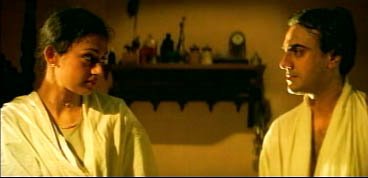
It is a story about the age old struggle of old and new, the traditional and the modern, told from the twilight hour when the change is imminent but is not yet there. Rajit Kapoor, the Hindi TV-serial and independent film actor portrays the eldest son of the Namboodiri household, the half brother of Thankam and Shobhana’s husband who has given his life over to practicing the traditional values of Hindu dharma. This leaves the newly-wed Devaki in a lurch, a virtual prisoner in a traditional household where even reading is considered as a crime for women.

The story progresses through the tribulations of Devaki, her friendship with Thankam, the effect of wider social changes like the independence of India from the British and the emancipation of women thereafter. The direction by Shyamaprasad brings to life a very moving and hard-hitting visual statement.
Share:

Oct 24, 2006

Poocha Sanyasi

One of the first full length comedy films in Malayalam, Poocha Sanyasi (1981) stars Raj Kumar in the leading role as the flirtatious playboy son of a millionaire businessman(K. P. Ummer). I wonder how Raj Kumar came to play lead role in Malayalam movies, he obviously doesn’t look anything like a Malayali, infact to me he looks a typical Kannadiga or Konkani. Anyway the guy did a load of Malayalam movies in the early eighties, most of them in the comedy genre.
  
Rajkumar and Madhavi in Poocha Sanyasi 

Coming back to the movie, since the leading man is a playboy there is a bevy of beauties surrounding him in the first half and in the second half he is blissfully (bliss will soon be lost as his former girl friends start plotting against him) married to Madhavi(again a non-Kerala import who tried hand in Bollywood movies where success eluded her that she had to move Malayalam, she was a strong presence in Malayalam movies in the eighties.) The wife(Madhavi) was chosen by the playboy’s strict disciplinarian father(K. P. Ummar) to correct son of his wandering ways. Comedians Bahadur, Kuthiravattam Pappu and Sukumari have major roles as well. A surprise role was that of Balan.K Nair, who excelled in villain roles during this period, but has an interesting part as an Anglo-Indian party-animal, the brother of one of the girl friends who morphs in to a convincing villain in the climax scenes. I also glimpsed Silk Smitha – the one-time sex siren of the South as an extra in one of the dances.
Share:

Oct 13, 2006

Sreekrishnaparunth : Movie Review

Long time back, sometime in the prehistory when I was in primary (elementary) school I was a voracious reader of, now comes the important part, "Ma" magazines in Malayalam. 'Ma' magazines were weeklies that published serialized equivalents of Mills and Boons type novels and had huge readership across Kerala. I quit this juicy reading habit three of four years in to it when I got bored of similar stories in different guises. 

Sreekrishnaparunth(or Kite - the bird) was a serialized novel, if I am right, which used to come in Manorajyam, one of the leading Malayalam weeklies at the time. It was quite an enthralling read because it had scandal, voodoo, sex, gore and all the other masala wrapped up in a seemingly historical plot.

Mohanlal, plays the main role of the magician/healer in the film along with other actors. The story takes place in a Kerala Namboothiri tharavad (Brahmin household), the patriarchs of the family are magicians / healers / shamans. Mohanlal, plays the lead role of Kumaran, the next head of the family but at present a local Casanova of sorts. 

Sreekrishnaparunth a.k.a the Kite is the family deity which protects the family and the master shaman from evil powers, thus the title of the movie. The movie starts off with a disjointed narrative without much character development, stories and people cropping up as it unfolds. It seems like it has been lifted straight off the novel and made in to a film sans a coherent script. For me it felt like reading a comic book with human characters come to life.
Share:

Oct 7, 2006

Thazhvaram

Thazhvaram, directed by Bharathan and penned by M.T.Vasudevan Nair is perhaps the first real Western in Malayalam cinema. Highly remniscent of Sergio Leone masterpieces like The Good The Bad and The Ugly and For a Few Dollars More, the wild west in Kerala is the 'thazhvaram' or the valley. The high-ranges or the Western Ghat region of Kerala and the valleys thereof have always attracted the adventurous and the pioneers. Symbolically these places are the closest Kerala has to the unchartered frontier that was the old West in America.

Mohanlal is Bharathan's protagonist, so often portrayed by Clint Eastwood in Leone's movies. The terse talking lone ranger seeking revenge is wrapped in a signature Indian poncho in case of Eastwood, here Mohanlal sports a black wool shawl striped with red which is infact worn by farmers in the region.

The film opens with a long shot of the lone human figure, slowly advancing against the magnanimity of the landscape(or whatever magnanimity you can wrestle out of a Kerala landscape.) A wailing, haunting instrumental typical of Westerns plays in the background.

There are four main characters in the movie, they are pretty much all the people that feature in it, there are not many distractions. It is beautifully shot and never wavers from its course. Salim Ghouse, a Hindi TV serial actor, remember Bharat in Doordarshan's campus drug drama of the late eighties - Subah, is the guy who plays the villian in this film. Shammi Thilakan has dubbed for him here. Sumalatha and Shankradi makes the rest of the caste along with the villian and the hero.

The final scenes are also very Leone-sque with the fight taking place in a large open space with vultures watching over. And then the lone ranger leaves once the fight is over, end of story. A very good movie by Malayalam standards.
Share:

Oct 3, 2006

Malayalam : Uyarangalil

The current quality of Malayalam film is so deplorable that old I.V.Sasi movies look like classics now. Or it could be that I.V.Sasi is an underrated director, atleast he was in my view. It changed considerably after I watched Avalude Ravukal, supposedly semi-porn, but with Sherif's script and I.V.Sasi's direction I found it to be classic, earthy and real.


Nedumudi Venu and Rehman in Uyarangalil


Uyarangalil, has Malayalam super hero Mohanlal in an anti-hero role, a choice not often made by up and coming actors as he was in 1984 when this movie came out. Rehman, the then teenage heart throb also has an important side role. The two Bollywood wannabes who failed to make it in Hindi films and took resort in Malayalam, Swapna and Kajal Kiron also feature in the movie. I wonder where these actresses are and how they look like these days. There is so little information about these actresses, infact Kajal Kiron is not even mentioned having acted in a single Malayalam movie in her IMDb page, though she has acted in quite a few of them in the early eighties.

Kajal Kiran and Mohanlal in Uyarangalil

Coming back to the movie Uyarangalil, story and screen play is by M.T.Vasudevan Nair, one of the gifted writers in Malayalam literary arena. A supposedly masala movie of the 80s, it has good dialogues and unpretentious and taut story and direction. Although this definitely was not a path breaking movie of any sort, just an ordinary run of the mill stuff in those days, it seems so polished and precise when compared to the movies dished out by Malayalam movie industry these days.
Share: