A movie and book review blog

Oct 18, 2018

Karwaan


Road trip movies seem to be the route of choice for Mollywood actors for their Bollywood debut. If it is a Bollywood road movie, it invariably has Irrfan as the laid back, philosopher of life who nurses a can of worms of his own – not too lethal, just enough to cause some minor hiccups to spice up the story line (Piku, Qarib Qarib Singlle, Karwaan)

We had Parvathy making her Bollywood debut with Irrfan in an Indian take on eat-pray-love called Qarib Qarib Singlle. Now we have Dulqar Salman taking the south Indian scenic route with Irrfan in Karwaan.

In addition to the gorgeous Nilgiris and Kerala lagoons, the other key elements in this movie are an indian youtube sensation – Mithila Palkar, a couple of dead bodies and Hindi – the lingua franca of southern India, if we are to believe Karwaan.

The story is by ad-man turned director Bejoy Nambiar and directed by Akarsh Khurana. The dialogs are natural, photography showcases the best of South India and the actors have tried – but the story lacks juice and feels forced in most places – I made full use of the fast forward button.

Dulqar’s acting was the most believable and Irrfan plays Irrfan – a slightly off the rocker, lovable eccentric. This could be a short film for Kerala (and Tamil nadu) tourism, starring a Mollywood celebrity and a Bollywood celebrity – if we can edit this down to about 15 min.


Share:

Oct 17, 2018

Paperback Reviews

Six Seconds by Rick Mofina : Fiction, of the throwaway paperback kind that you can comfortably leave in an airline seat pocket or the departure lounge once you've finished it. It's been ages since I read something of this category. It was ok, an extremely fast read, mostly because I was skipping the obvious. The beginning was good, that was why after reading a few sample pages I decided to check it out. I would not get into the science behind the story or implausibility of certain events, all in all it was a quick engrossing read with chapters which can be skimmed in a few minutes.

The Girl on the Train by Paula Hawkins: An emotional book about unhinged people. Not sure how it became a huge hit. I guess it just goes on to prove that the reading population has very different tastes than me. Meh.
Share:

Oct 7, 2018

Kannur : Inside India's Bloodiest Revenge Politics by Ullekh NP and a companion movie Eeda

Red - Kannur breathes and radiates red. From the laterite hills to the communist party flags and from its blood killing fields to its iconic Theyyams, red is the go-to color of this west coast city at the northern tip of the southern Indian state, Kerala.

With my personal connection to the place, it would have taken some significant amount of restraint to stay away from the red-jacketed book titled Kannur : Inside India's Bloodiest Revenge Politics by Ullekh N.P. The author is a native of Kannur and a journalist with Open Magazine.

The book tracks the history of violence and blood-letting that has become synonymous with the Kannur as the political killing capital of Kerala. Many faces and names of people appearing in these pages reminded me of people we might have ran into at an afternoon political discussion, at a panchayath function or at the neighborhood AKG vayanshala, all those years ago in the eighties.

My impression of the eighties Kannur, where Congress party and CPI(M) as the de-facto rivals contradicts the murders painted by numbers in this book. It is true that post-1990s, after the Babri Masjid demolition, religious fundamentalist organizations like RSS made considerable inroads into Kerala, one of the last bastions of the liberal left in India and thus replacing Congress as the main enemy for CPI(M) in Kannur. The passing of the mantle of the main CPI(M) enemy from Congress to RSS (BJP) is not evident from the narrative. At present almost all (if not all) the political killing victims are either Marxists or Hindu nationalists, Congress party members are nowhere in the picture.

The book also explores the question, why? Why did Kannur become the hot-bed, by exploring some unusual theories about the social, historical, genetic and geographic composition of the district and its inhabitants. From Chekavars to Assyrians to Portuguese it is fascinating to see various interpretations of history in an investigation to make sense of the mess.

...........

Eeda (translated as Here)is an excellent fictional companion piece for Ullekh N.P's book. It is a contemporary look at the political rivalries of Kannur through a Romeo-Juliet angle. Communists and Hindu nationalists stand in for Montagues and Capulets, while a young couple tries to escape the tentacles of their inherited political legacies.

Shane Nigam (Kismath) and Nimisha Sajayan (Thondimuthalum Drikthasakshiyum), the protagonists come from similar families in Kannur except their political affiliations - one with strong Marxist connections and other with Hindu nationalist leaning, which is the other side of the tracks as far as the other is concerned.

It is a smooth, natural flowing movie, the directorial debut of editor turned director B. Ajithkumar and Collective Phase One. Although other than the lead couple's accent, most of the other characters do not sound like locals, it is not because they didn't try. There is an impressive lineup of supporting characters essayed by Alencier Ley Lopez, Surabhi Lakshmi, Manikandan Achari, Sudhi Koppa and others.

Share:

Oct 6, 2018

Kannur, an old post : A prelude

Kannur is close to my heart, for undisclosed reasons. I have spent many childhood summers tearing across its red laterite hilltops and endless cashew groves with the local kid brigade. I had written a few lines in my old blog about this piece of heaven I was fortunate to spend a few weeks every summer, cut-pasting it below..... (I am running short of writing fuel that I have to resort to rehashing my old stuff.) I was planning to post a movie and a book review, both set in Kannur. But from the length of it, the reviews will have to wait, here's the prelude first.

Kannur is one of the northern districts in the southern Indian state of Kerala, on the west coast of India. Here's Kannur's Wikipedia page.


a post from Oct 17, 2009
Paradise in those days of bruised scabby knees and wild hair was set in red laterite country. It had grandmothers who moved around in an ether of Ayurvedic oils handing out admonitions and sweat-meats with equal ease. The main citizens of this nation were a mob of tanned and rowdy cousins who would crawl out of the woodwork the minute we city-dwellers landed. Within the next few weeks we’d map every nook and cranny of the wild farmlands to the last earthworm and the last dragonfly (Dragonflies were particularly useful as these when tied with a string on their tails could be used as backhoes for picking up stones.) Our feet would tear fields and playgrounds to shreds as a determined sun watched on while vaporizing an occasional itinerant cloud.


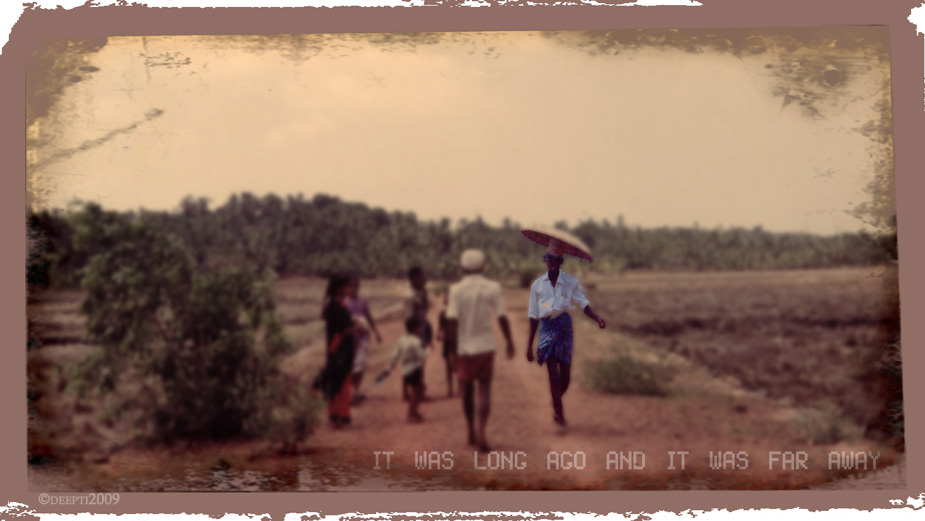
…..and what you see above is a piece of that paradise. If it was a human this photo will be eligible to purchase and consume alcoholic beverages by this year. It doesn’t know what it is missing. But you know. You are looking for 72 virgins, swaying palms and cool emerald water that are notable by their absence in my dated version of paradise. Instead what you see on either side of the mud road are rice fields getting roasted in ample solar radiation typical of April in South India. A river which could’ve salvaged the otherwise dry and dusty frame hides a couple of hundred meters behind me, the photographer.

I took the picture with my trusted Yashica. A few of my cousins and my sister are in the photo. The two men in lungi are passersby. The photo has been tickled a bit by my funny photoshop bone. I couldn’t help but contribute to the mutilation of the photo already warped by time, weather, scanning conditions and a 13 year old amateur camera aficionado. The only person untouched in the picture is the man wearing thoppikuda (thoppi= hat, kuda = umbrella.) It is my homage to an extinct age when thoppikudas could travel inconspicuously in public without eliciting puzzled glances and when I was at an age, like the one perfectly summed up in this song,

It was always summer and the future called
We were ready for adventures and we wanted them all
And there was so much left to dream
And so much time to make it real

Earlier in the day this song (or rather the refrain, I do not know any song beyond their chorus) was making rounds in my brain. Sung by the beefy bard of modern rock ballads a line from it was adopted by automakers world wide and affixed on many rear-view mirrors. The automakers might claim it was the other way around. But I wouldn’t doubt the ingenuity of bards of any kind, from anywhere, whether from New World or Old Country.

I’ve unstuck a line from the lyrics and have pasted it on the photo. The rest of it is here.

..There are times I think I see him peeling out of the dark
I think he’s right behind me now and he’s gaining ground

But it was long ago and it was far away, oh God it seems so very far
And if life is just a highway, then the soul is just a car
And objects in the rear view mirror may appear closer than they are

Like Kenny in the song this photo has a cousin of mine who is with us no more (you can only see his brown legs, not his face) and there are times I think I see him peeling out of the dark…..I am thirteen again and it is summer blazing up in the lost paddy fields in far-off Malabar.


Share: