A movie and book review blog

Mar 30, 2022

83 : A movie review, reliving Prudential Cup almost 40 years later

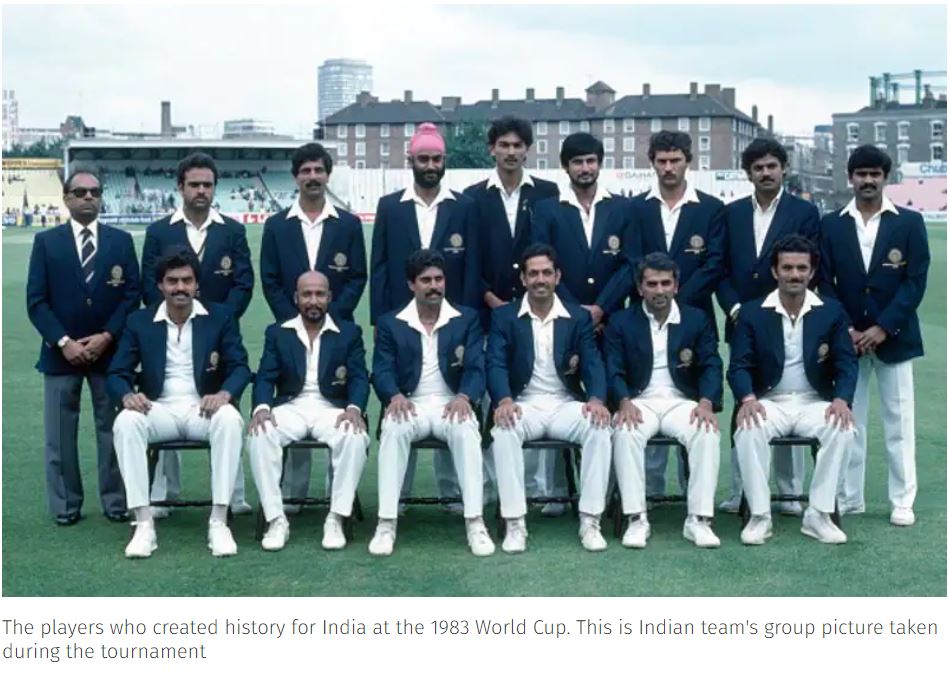
1983 Prudential Cup is my cup of frisson on demand. I just have to glance at the pictures of a grinning Kapil Dev holding the '83 world cricket cup or people overrunning the stadium at Lords to get auto-response goosebumps. As a grade schooler, I had my own scrapbook filled with newspaper cuttings of India's first ever win of a world cup of any sort.


Whether India likes it or not, English and Cricket are the two lasting colonial legacies the British left the Indians with, in return for Kohinoor and centuries of continuous looting of India's resources and treasures. Both English (the language) and cricket have stood India in good stead, have been important catalysts helping to grow the Indian economy and establishing India on the global scene. The British East India company is the reason why this blog is in English. My love for cricket is the reason for this post.

Living  deep in no-Indian (East Indian, not native American) country, I was waiting for a streaming service to release 83, Kabir Khan's retelling of India's 1983 Prudential Cup journey. Finally it aired on Netflix last week. The best part about 83 is the effort the director and his team have put in getting the details right. The players, their playing styles and mannerisms, the events and situations they find themselves in have all been depicted as close to reality as possible. I know, because they are in my newspaper clippings scrapbook :-)

Another redeeming point for the director is he succeeded in capturing the swagger and the intimidating presence that was the West Indies team of the late 70s and 80s. 


Considering the kind of attention to detail given to the style and stance of the individual Indian players and the cool West Indians, I have tried to overlook the cringe inducing jingoistic or sentimental elements that a Bollywood movie cannot do without, which 83 couldn't get rid off completely either. A fictional 
ceasefire at the farthest outpost in the Himalayas on the day of the finals! I am just glad that we narrowly escaped suffering a patriotic song sung by soldiers in sub-zero temperatures. It didn't do well at the box office despite critics (and I) loving it. Maybe the current audience, mainly millennials and younger, could not relate to it? 

The actors, including Pankaj Tripathi as the team's manager have given great performances. Kapil's Devils as the Indian team was called back then, are represented in the movie by Saqib Saleem playing Mohinder Amarnath , Tahir Raj Bhasin as Sunil Gavaskar, Jatin Sarna as Yashpal Sharma,  K. Srikant  played by Jiiva, Sandip Patil played by his own son Chirag Patil, Nishant Dahiya as Roger Binny and others. The greatest discovery for me though, is Ranveer Singh, who essays the role of the captain Kapil Dev Nikhanj.

Ranveer Singh, with his penchant for outrageous outfits, has the persona befitting an offspring of a peacock and an eccentric fashion designer if such a coupling could have happened.  I had never really given him much thought as an actor. In fact when they announced casting Ranveer Singh as Kapil Dev, instead of say someone like Randeep Hooda who is from the same area in India as Kapil Dev and is a sportsman in addition to being an actor, as a fan of Kapil Dev I was disappointed. 
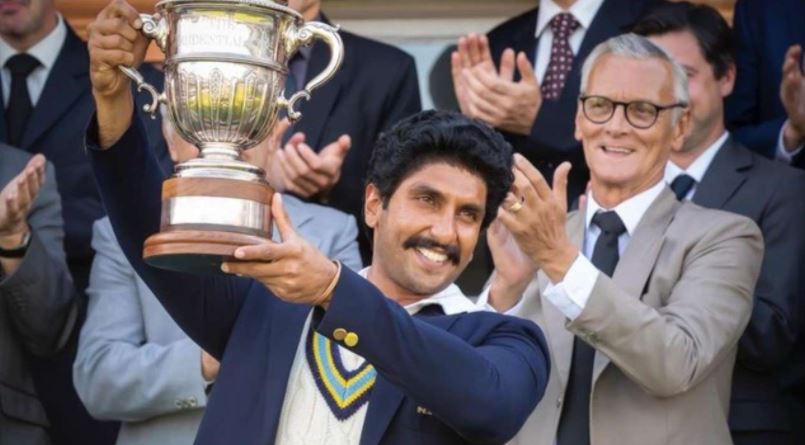
Ranveer Singh as Kapil Dev

Then I saw Ranveer Singh in 83 as Kapil Dev.  The entire production team and the actor himself have gone into so much detail getting into the skin of real Kapil Dev, that the audience is unable to see Ranveer Singh anymore. That's when I realized that Ranveer Singh has been proving me wrong with his every recent outing - whether it is Gully Boy or Padmavat or 83, the guy can act. At this point I would rate him as one of the best amongst the current bunch of younger Bollywood actors. 

83 is not Chak De India, which is probably the best Bollywood sports movie in my book. But it is history. Kabir Khan's 83, while it could have been better, has done a decent job depicting a momentous turning point in India's cultural history.


Share:

Feb 28, 2022

Munich: The Edge of War

Carl Jung's theory of synchronicity is  about the meaningful coincidence of two or more events where something other than the probability of chance is involved.  The reason I bring up synchronicity is I believe I had a light brush with it through the movie Munich: The Edge of War. A couple of days after watching the movie, we are in a history-repeats-itself situation with Ukraine, just as it had happened in the movie and history in 1938.

Netflix released Munich: The Edge of War on Jan 21, 2022. Maybe it was a far-sighted move on Netflix's part where their geopolitical team was scouring current events to find subject material for new movies. The team identified Munich 1938 as a plausible candidate to make a movie that people can relate to in the current times, when we have Hitler-lite dictating over Russia and looming like a menacing cloud over Europe. Congratulations earthlings, you were almost wrung out to dry by a global pandemic, how about World War III now? This is the roaring twenties, all over again, the excitement never stops.

A sucker for war movies, I had to put Munich: TEoW in my watchlist soon after it was released. It sat there languishing like the rest of the movies in My List, awaiting for my scroll button to pause on it and click Play. The click Play happened near Valentine's Day, a season I keep aside for watching war movies. But with my movie watching ADD at its peak, the bureaucratic nature of the movie felt a bit too slow for me and I left it there, after watching for about ten minutes. Then I picked it up again last week and finished it off soon after.  

Going into the movie I had no idea about the Munich Accord of 1938 or Hitler's invasion of Sudetenland (former Czechoslovakia,  current whatever) , which was the precursor of WWII. I am familiar with most of the famous battles of WWII thanks to WWII in Color (Netflix), but I am mostly clueless about the events leading up to the war, except having a general idea that Hitler's megalomaniacal territorial ambitions and the program of ethnic cleansing for racial purity eventually resulted in the war. 

Munich: TEoW plays out during the days before and during the signing of the Munich Accord in 1938. It blends history with fiction, where the fictional lead characters are two young government officials who went to school at Oxford together and are now on the opposing sides of the geo-political divide. Both are seen trying to prevent a war, within their extremely limited spheres of influence.
 

Based on Robert Harris's best seller and directed by Christian Schwochow, George Mackay who according to me is the most German looking English man, plays the English civil servant Hugh Legat and Jannis Niewöhner is his college-mate who is now a German diplomat. Then British PM, Neville Chamberlain has been given a makeover or a whitewash and is portrayed in the movie by the indomitable Jeremy Irons. The movie says that Chamberlain's much critiqued move was him deliberately allowing to tarnish his image in history for the sake buying time for the the rest of the Europe (or Allies as they will be called later) by sacrificing Sudetenland.

1938 in the movie feels like a time just like we are in now. Europe is poised at the edge of war, triggered by the actions of a madcap dictator who looks and acts like a man who must have had his black belt in judo revoked recently. Instead of Sudetenland we have Ukraine, a democratic nation whose President - the (multi) Talented Mr. Zelensky, is fighting on the front lines with his troops defending their capital city - Kyiv. But unlike 1938, it is not just European nations who are joining hands to fight the aggressor - here is a sample of one of the Allied partnerships* of 2022. 

*pornhub part was fake news

Yes, here we are. Showing a significant reversal from their post WWII stance, Germany has invested 100 billion Euros for its military expansion. Poland is praying that German forces will march into their country and save their back side if/when the need arises. Switzerland has stopped signing its emails with the pronoun - 'neutral' which was specifically invented for them right after Napoleon's reign and has announced sanctions against Russia, causing Russian oligarchs scrambling to buy piggy banks. 

In case we are still not convinced that this stuff is serious, Sweden and Finland who are the lesser known step-cousins of Switzerland and have never picked any sides just like their more well known cousin, have also picked a side, joining the Pope, Poland and Anonymous. It is not Munich which is at the edge of war in 2022, all of Europe is at the edge of unity. 
Share:

Dec 26, 2021

Best shows on Amazon Prime & Netflix: My 2021 List

This is my customary end of the year list post. I usually do best books, but this year I am going to the best TV shows I have watched this year. Some of them were even adapted from books! That gives us one more reason not to read books, we can wait and watch when the show comes out.


My discovery of the year or my best TV show award goes to The Man in the High Castle on Amazon Prime. Here is the list of my top 10 tv shows of the year in no particular order, except for the one in the first place.

First Place - The Man in the High Castle (Prime): I like history. I like time travel and alternate universes. I don't really like science or fantasy fiction. But I am starting to like Philip K. Dick more than ever. He is the only science fiction writer I have ever enjoyed reading. 

The Man in the High Castle is history, time travel and alternate universes baked fresh from the kiln fired up right after WWII. It is based on Philip K. Dick's book of the same name. I started reading the book after I finished the show which is on Amazon Prime. The show is told from a different perspective than the book. The creators and the actors have kept it engaging, charismatic and it leaves us wanting more. Incredible performances all around. I am particularly impressed by Rufus Sewell who steals the show.  A.M.A.Z.I.N.G. If you are a history buff with a weakness for alternate universes, this one is for you.


The Underground Railroad (Prime): What if the underground railroad was a real subterranean railroad transporting slaves to the free lands up north ? Based on Colson Whitehead's Pulitzer winning novel of the same name, Barry Jenkins' poem of a show is a hard-hitting portrayal of the ambitious and risky flights to freedom undertaken by slaves from southern plantations in the mid 1800s. 


Them (Prime): Amazon Prime has more authentic shows about black people than Netflix. While it has garnered many negative reviews from critics, I liked the period aspect of Them and how it shows a family of four who moved to Compton from the Carolinas battle the duel evils of racism and supernatural evil. Are they one and the same?


Patriot (Prime) : If Wes Anderson was making TV shows, Patriot might be it. Maybe writer-director Steven Conrad is Anderson's brother from another mother. Patriot is about a spy, who cannot be identified as a spy, whose day job is at an industrial piping company in Milwaukee, who also moonlights as a folk singer as an antidote to his stress - the level of which would have killed any other person. It is serious and comedic at the same time. It also reminds me of Asian black comedy crime dramas where periods of silence are abruptly offset by loud action, then all goes quiet again in the next minute and the protagonist carries on with whatever mundane daily task he might have been doing - like sharpening a pencil or reading a bus time table.


The Serpent (Netflix): The exquisitely shot, directed, edited and acted crime drama, The Serpent, follows the notorious criminal and serial killer Charles Sobharaj. Sobharaj was our version of Clyde, of the Bonnie and Clyde fame. There were several Bonnies in the real Sobharaj's story, although in this TV version, Bonnie is Marie-Andrée Leclerc . When I was a kid back in India, Sobharaj was captured and jailed for a brief time in Tihar jail from where he escaped using one of his ingenious schemes. It was great to see re-creation of sixties and seventies, going down the hippy trail in Asia on the tail of a notoriously manipulative psychopath. The production design and casting are on point.


Kim's Convenience, Seasons 1-4 (Netflix) : The best Korean show ever to be made by North Americans. Set in Toronto, it tells the story of a four member Korean-Canadian family who owns a convenience store. While it is light, natural, funny and this is the most realistic portraiture of an Asian immigrant family I have seen on TV.


Harlan Coben series on Netflix: For quick binge-able crime drama, just like the Harlan Coben paperbacks you might pickup from the airport kiosk, the TV shows adapted from Coben's novels are eminently binge-able, no matter what the language. I started with Safe, proceeded to The Five and The Stranger - all produced in U.K, before moving on to The Innocent (Spanish), Gone for Good (French) and The Woods (Polish.) 


Midnight Mass (Netflix) : Midnight Mass is an atmospheric series. It gives me the vibes of Netflix's show Messiah, a favorite of mine which Netflix canceled after the first season. Maybe due to religiosity, which is a cornerstone for both the shows. If you are in the mood for some dark moody horror with depressive undertones that rounds things off with a fiery apocalypse, too specific I know, then you might want to give Midnight Mass a try.


You (Netflix): How does a serial killer who is a book store manager ingratiate himself into high society and find his prey? Watch YOU for the answer. Based on the books by Caroline Kepnes, the protagonist could be called Dexter with a literary bend of mind. Addictive.


If I Hadn't Met You (Netflix): I will take time travel and alternate universes in any language. Si no t'hagues conegut is a Spanish Catalan series, a love story in disguise of a time traveling trope - that's what I fell for.

Other honorable mentions because I am too lazy to write.

The rest of my best on Amazon Prime you have probably not watched, yet.
  • Hotel Beau Sejour (Belgium) : Supernatural crime drama with the protagonist murdered, caught up in an after-life limbo, trying to find her killer.
  • Unforgotten (U.K) :  British crime series starring Nicola Walker and Sanjeev Bhasker.
  • The Living & The Dead (U.K): Victorian era super natural of a farmer-scientist trying to prove the existence of after-life, starring Colin Morgan.
  • Intruders (BBC America) : Stars Stranger Things star Millie Bobby Brown before she was famous. Supernatural.

The rest of my best on Netflix you might have watched already.
  • Delhi Crime (India): Best Indian crime drama ever.
  • Clickbait : Crime thriller set in the U.S, but Melbourne stands in for U.S west coast.
  • The Chair : If you have always wondered what happens in academia and what do these professors, especially the ones who teach languages do, The Chair is a quick and easy watch.
  • How To Sell Drugs Online Fast Seasons 1-3 (Germany) : Real life Breaking Bad about the true story of a teenage German entrepreneur. Engaging and funny.
  • Never Have I Ever Seasons  1-2 : Teen drama. Mindy Kaling takes a look at the troubles and travails of teenage angst, through her protagonist, first generation Indian American teen, Devi Vishwakumar


Share:

Dec 4, 2021

Unsettled Ground : Notes on a book

A county, a college, a national forest, public schools and dozens of other enterprises including an upscale hotel and a church memorialize the nineteenth century Protestant missionary Marcus Whitman.  He would have been a footnote in history if he and his wife and eleven other white people were not killed by Cayuse Indians in 1847 in Walla Walla valley in the Pacific Northwest.  

I picked up this book by Cassandra Tate on one of my rare in-person visits to the  Public Library. I had no particular subject or book in mind. After a few minutes of wandering around I found myself in the local section - Washington based books and this book caught my eye. I finished it a few days ago, reading it over a period of several weeks because unlike the ebooks I read these days, a hard copy book cannot be read in the dark. 

Coincidentally I finished the book on Thanksgiving day, the day marking the autumn harvest feast shared between the native Americans and white colonists at Plymouth, Massachusetts. Former President, Warren G. Harding said, "I like the story of Whitman. If it isn't true, it ought to be." Thus the story of a hero (non-existent in reality) was created, a convenient portrait (there were no portraits or drawings of the Whitmans) of a chiseled white frontiersman missionary was written and sculpted into a nation's memory and museums.  In an era when across the United States the statues of old White men are being toppled by the new generation trying to re-align history and correct past mistakes, Unsettled Ground is a timely read. 


Like all the historical stories painted by the victors, the stories of native Americans and white colonists' interactions have always presented Indian tribes as the bad guys, attacking and revolting against the white pioneers and well meaning white missionaries.  The Whitman story is no different. Tate's well researched, even-keeled book prompts a revisit to learn the truth about the complex dynamics of Natives and white settlers, from the perspective of an infamous event, which led to the canonization of the wrong hero.

Here are a few intriguing facts I learnt from the book:
  • Tate points out, when American Indians killed whites it was called a “massacre”; when whites killed Indigenous people, it often gets labeled a “battle.”
  • Catholic missionaries had more success and rapport with the native Americans than Protestant missionaries in the American west because of the high threshold of entry (into Christian religion) that Protestant missionaries set for the new converts. The Catholics on the other hand were ready to baptize and convert even those 'heathens' who were ordered to be hung to death the next day, if the heathen wished to embrace Christianity.
  • In early nineteenth  century it was more difficult and time consuming to complete one's theological education and be ordained a priest or a minister (took 7-8 years) than to study and qualify as a physician which only took about four years max.
  • The focus of Christian missionaries in the Americas was to change the wandering, hunter-gatherer lifestyle of the native people and convert them into agriculturists who would stay put, farm the land, produce and procreate in one place.
  • Oregon Spectator talking about the native Americans, "for the barbarian murderers and violators, let them be pursued with unrelenting hatred, let them be hunted as beasts of prey, let their name and race be blotted from the face of the earth, and the places that once knew them, know them no more forever."
  • The Whitmans were markedly unsuccessful  as missionaries - in their 11 years in the Pacific Northwest they failed to convert even a single Indian.
Share:

Nov 25, 2021

Churuli : A properly prejudiced analysis

Lijo Jose Pellissery(LJP) is the messiah Pooh Bear of the new new-wave Malayalam cinema with his growing ranks of proselytizing followers of the male kind. He had started amassing this cult following since he had Fr. Vincent Vattoli perform miracles in his 2013 film, Amen. In my books, Amen was the last amazing film Pellissery directed
Amen painted a Gabriel Garcia Marquez-esque story on the vibrant and verdant canvas of Kuttanad. If the audience had missed his previous film - the raw and experimental City of Joy (had a lot of Amores Perros in it) Amen established LJP with a bang. He almost missed the mark with his audience in the next one, Double Barrel, although I had liked it. But I am not his audience. Then came Angamaly Diaries, Ee.Ma.Yau, Jallikattu and this latest film I watched a few days ago – Churuli.  
Every one of these later films are darker and progressively masculine. I must have made half-way through Angamaly Diaries, got quarter way in to Ee.Ma.Yau before giving up and didn’t attempt Jallikattu at all – India’s official entry for Oscars (Feb 2021.)  

Churuli is his 2021 release, the first movie in Malayalam that explores the possibilities of watching a movie using a VR headset. The interpretation of Churuli is best left to film critics who name drop Kurasawa to Kubrick and Tarantino to Tarkovsky to Truffaut with a side of Lijo over a cup of coffee and not someone like me, who has a biased view of LJP films. These eminent film critics might have already reviewed Churuli on hundreds of review sites and reaction videos. LJP fans, please head on over there, there is nothing for you here. But if you are here for a properly prejudiced and completely kosher (unlike the film Churuli, my review will be 100% expletive free) review, continue reading. 

Churuli means a spiral or a circular maze in Malayalam. According to Maze Building 101, some mazes have bridges, obstacles and other interesting features like boot-leg liquor stores, fire-balls and surreal characters which add to the character and mystery of the maze. Our neighborhood Halloween corn maze has Freddy Krugers and other similar boogeymen jumping out with torches or fake chainsaws. It is pretty impressive on a dark Fall night, even when you know it is all fake. Churuli also has that dark atmospheric effect (better viewed on VR headsets than wide screen TV), reinforced by its story, dialogs and cinematography, taunting the audience to discern between the real and the unreal or just enjoy the ride.

It also has an ominous bridge. Yes, the same bridge we all put off crossing till we come to it. The two main characters in Churuli are afforded no such choice - they have to cross the bridge after which the mood of the movie changes abruptly. These two undercover cops cross the bridge to reach the high range settlement called Churuli. They are in pursuit of a criminal named 'Joy' who is supposedly hiding in this settlement.

In addition to the bridge, the maze @ Churuli has a liquor store turned makeshift church and a handful of frontier roughnecks - an authentic wild West setting. The lingua franca of this mountainous labyrinth is Malayalam laden with un-adulterated 100% pure profanity, most referring to female genitalia. The film is also notable in the absence of any significant female characters. A couple who are there could have been the products of hallucinatory maze, if you ask me. 

I appreciate the presence of a director like Lijo Jose Pellissery in Malayalam cinema, the one who bravely explores different story telling configurations in his films. From the hyperlinked format (City of God, 2011) to magical realism (Amen, 2013) to alternate world building while exploring the animalistic tendencies in humans (Churuli, 2021) LJP has presented engagingly unusual cinematic compositions to Malayalam audience. 

But somewhere during that journey, LJP lost me and I stopped putting any effort to appreciate or understand the innovation he has been putting forth. Totally my loss, I guess.

Share:

Nov 2, 2021

Silsila : A review

Living in eighties and nineties India it was hard to avoid watching Silsila. The movie and its songs were always on some channel or the other. I absolutely could not stand watching Amitabh Bachchan and never found out what his appeal was. Still don't. I waited 40 years before taking the plunge to watch Silsila and decided to watch it on whim the other day when I saw it on Amazon Prime. 

Amitabh Bachchan, Jaya Bhaduri Bachchan and Shashi Kapoor in Silsila (1981)

Yash Chopra's 1981 romantic classic ventured into the taboo area of extra marital affair and had Amitabh Bachchan, the reigning super star of Bollywood at the helm. Watching the movie now, I am amazed how some of Amitabh's mannerisms are reflected in Shah Rukh Khan. Although I have heard this mentioned before this is the first time I have noticed the similarity. 

Rekha and Sanjeev Kumar in Silsila
The movie fared below average when it was released in 1981, probably because it almost succeeded in having the audience empathize with the cheating husband and the other woman. Not exactly the kind of film the audience want to concede that they related to, considering how sacrosanct the institution of marriage was in India in the late 20th century. It is regarded as a classic now.

The screenplay is smooth, the actors have given great performances. It is a treat to watch Sanjeev Kumar and Shashi Kapoor, the other big name stars in addition to the love triangle trio of Amitabh Bachchan, Jaya Bhaduri Bachchan and Rekha. It was quite a casting coup that YRF achieved by casting the real life couple Amitabh Bachchan and Jaya Bachchan together alongside Amitabh's alleged mistress Rekha in exactly the same roles as IRL 

Here are some gossip column snapshots about the film, from way back machine.


Share:

Oct 30, 2021

Sardar Udham

To narrate the biography of a freedom fighter without sounding jingoistic is not an easy undertaking. Shoojit Sircar's Sardar Udham is an understated piece of film making we don't see much in Bollywood in these days of Bell Bottoms, Kesaris and Bhujs.
Vicky Kaushal as Sardar Udham

The casting is spectacular.  Vicky Kaushal is becoming the thinking person's hero,  who straddles the line of commercial Bollywood and alternate cinema with the ease of a seasoned tight rope walker. From essaying a teen to a forty year old, the effortlessness which with Vicky gets into the skin of the character in Sardar Udham is admirable. Did I say I like Vicky Kaushal? He is so quintessentially Indian - could be from North , South,  East or West of India.
The production design leaves no room for finding historical mis-steps. The British characters are not monsters, the subjugated Indian patriots are not embodiment of morality and virtue, all are faulty humans, victims of their circumstances.The cinematography is amazing, it has one of the best depictions of Jalianwalla Bagh massacre ever shown on screen. Even in the imagery representing brutal slaughter of hundreds of people, India is painted with a breathtakingly poignant brush with striking colors.
The movie is a bit of a slow burn, especially for someone like me whose fingers are glued to the forward button on the remote. But I understand,  Sardar Udham is like an episode of Oliver Stone's Untold History of United States India, you think know the story,  but you don't, so you will yourself to watch a skillfully crafted old school film making, word by word, moment by moment as history unfolds. 

Ram Muhammad Singh Azad or the real Udham Singh in British custody
An ordinary Indian guy plans and prepares (flying solo for the most part) for his revenge, on a representative of the British Empire. It takes him 20 years to complete his mission of eliminating his target, his revenge for killing 1500 civilians in his hometown of Amritsar. The British never formally apologized for the massacre, but expressed 'regret' on the 100th anniversary of the event in 2019.


Share:

Oct 9, 2021

Korean Content : Best Korean shows on Netflix

Like half of the planet, I too am majorly into Korean shows these days. No Squid Game or Korean rom-coms for me. But even if you don't watch rom-coms or fictionalized game shows where characters get killed for money, there are plenty of stars to gaze at in the Korean media multi-verse. Here is a list of my favorite Korean streaming content that I had been bingeing on :

Reply 1988 : 1988 in Korea was not very different from the 1988 in my part of the world, when I had just entered my teens. We had small boxy cars, CRT TVs and sat on the floor and had dinner even when we had a proper dining table. Reply series is an anthology series with 3 seasons. It started with Reply 1997 in 2012, Reply 1994 in 2013 and Reply 1998 is the last season that started airing in 2015-16 and the only one I have watched in its entirety.

All the seasons are disconnected except a common concept that they are all about a group friends and their lives during a particular year, a turning point in their lives. Some of the actors re-appear, playing a different character in a different season. The last one, Reply 1988 is the most popular and by the third season it looks like the makers  of Reply series had perfected the formula for success. Reply 1988 is one of the highest ranked TV series in Korean cable TV history. 

Reply 1988 is the story of 5 families with teenage kids in the same neighborhood of Seoul growing up in the late eighties. The success of the series is the connection you will develop with the characters as it progresses - all fifteen of them. With 20 episodes almost an hour long it is a serious commitment, but once you get hang of it, you wouldn't want to get off that train. I almost gave up after first couple of episodes, but I am glad I did not.

Below is a quote by the female lead from the very last episode of the series. She is the one in the middle row, dead-center.

 “1988. This is the end of our Ssangmundong story. Longing for that time and longing for that street isn’t because I miss the younger version of myself. In that place, where we won’t be able to gather like that again, I regret being unable to say my final farewell. To the things that are already gone, to a time that has already passed, I want to say a belated farewell. Goodbye, my youth. Goodbye, Ssangmundong.


Stranger (Secret Forest in Korean), season 1 : A police woman and a prosecutor team up to solve a political mystery / crime. The handful of main characters are complex and evolve as the story progresses. If you like detective stories or crime thrillers with a legal angle, a la John Grisham, Stranger is it. It was also featured in NY Times list of top international TV shows for the year 2017.

Hello, My Twenties (Age of Youth in Korean), season 1 : 5 girls sharing a house as they embark on their college journeys, part time jobs and share their growing pains. Been there. Done that. I could relate to it more than I could ever relate to Sex & the City or Friends. Both of those I have only watched sporadically, before the days of Netflix or other streaming platforms. How can Carrie Bradshaw writing a worldly wise weekly column in some New York newspaper afford to live in an upper East side brownstone? What could be more further from reality than her implausible NY life with her craze for Manolo Blahniks?
I was not really sure of Hello, My Twenties during the first episode or two. But once past that, the characters started to grow on me and their struggles and happiness started to matter. I finished the first season in a couple of days, but I couldn't bring myself to watch the second season as they switched out the actor - my favorite of the five girls, with a different actor. Thus my revisit of the twenties ended abruptly with Season 1.


Sisyphus - The Myth : If you like sci-fi, you might like Sisyphus. The lead actor from Stranger is also the lead in Sisyphus, that is what first lead me to it. It is also TV-14 which meant I was able to watch it with my kids. Sisyphus is not exactly the best of the best K-drama and it only appeals to a certain kind of audience. You have to check reality and logic at the door. It was good for a light one time watch.

Chicago Typewriter : I find that with Korean dramas or probably it is the case with every foreign language TV series or film, if I like some of the actors I try to find out if anything else is available on Netflix or Prime that these actors have been featured in and if there is, I give it a try. I started watching Chicago Typewriter when I found from Wikipedia that one of the actors from Reply 1988 was in it and it was available on Netflix. Also the theme of the show looked intriguing - how were they going to establish a Korean connection to Chicago, through a typewriter?  There are only a handful of characters, and it could be summarized as a sort of time-traveling ghostly love triangle involving a typewriter. The three main leads are strong and convincing. You cannot apply human logic to ghostly deeds so even if you have questions you can attribute the lack of answers to the ethereal nature of the story.

A couple of other Korean TV shows I had reviewed are here - Tunnel & Signal. These are the shows which got me started on K-drama, in case you are looking for a gateway drug to Korean content and don't really care for rom-coms.


Share:

Sep 27, 2021

Plague64 & Covid19: How Daniel Defoe's A Journal of the Year of the Plague foretells our 21st century reactions to the global pandemic

I try to stay clear of fads of all kind if I can. It is a bit easier for me than the general populace because I do not have any social media accounts to be bombarded by trends from friends' feeds, tweets or stories. The only place I might be ambushed by fads are the streaming platforms (Netflix, are you a verb yet?) and books. All I have to do is turn a blind eye to all the pandemic movies, books and documentaries in 2020 or not take a peek at any of the 9/11 documentaries/movies in 2021. I made my first Dalgona coffee yesterday after making sure the Dalgona fad was dead beyond resuscitation. A year after a fad has passed seems a reasonable time frame to check back up on it and not be branded a blind follower if you want to try it out.


Now that the one year self-imposed steer-clear date has passed for catching upon pandemic literature and media, on a mission to elevate my literIQ, I started browsing the classics catalog at our public library's online offerings. Half of which I had to dismiss because I had read the abridged illustrated versions of these in my youth and had marked these off as read. That was when I chanced upon Daniel Defoe's lesser known non-fictional fiction, or historical non-fiction/biography as we call it these days, "A Journal of the Plague Year" published in 1722. 

A note about Defoe before we move on.  Introducing the Penguin edition of the Plague Year in 1966, Anthony Burgess wrote: “Defoe was our first great novelist because he was our first great journalist...because he was born not into literature but into life.” 

Defoe was born into a non-aristocratic family with anti-establishments roots and had a liberal upbringing. He was a trader, a journalist, a pamphleteer, a spy and a writer who preferred modern languages rather than the classic languages that the ' true' writers were expected to write in those days. 
 
He produced an array of various forms of literature from pamphlets to novels under two hundred different pseudonyms. Robinson Crusoe is often considered the first English novel, the work that defined the literary device we call a novel now.  It was marketed as the strange and surprising adventures of a sailor marooned on a lonely uninhabited island for eight and twenty years, written by 'himself'. Defoe was the father of the line of writing which we now categorize as historical non-fiction, crime, pop science and travel non-fiction - the kind Eric Larson, Laura Hillenbrand, Bill Bryson, Jared Diamond, Jon Krakauer and Yuval Noah Hariri excel in these days.

A Journal of the Year of the Plague is in the form of an eye-witness account of the plague outbreak in 1665 London. Defoe must have been 5 years old at the time and had not yet added "De" to his last name to make it more classy. The novel was published in the form of a journal of a person with initials H.F and is presumed to be that of Henry Foe, Daniel Defoe's uncle who had lived and worked in London at the time of the infamous bubonic plague outbreak. Defoe also drew on historical records (broadsides), medical pamphlets and Bills of Mortality published by local parish authorities for counts and tables of plague deaths by parish and by chronology, that appear through out the book.

350+ years - light years in terms of technological advancement, vaccines, Instagram and Ivermectin separate the 1665 London Bubonic plague event from the global Covid19 pandemic of 2020. But as I read Defoe's uncle's journal it feels like our responses as a species have not changed even an iota. 

Here are some of the recurring patterns of human behavior and our predictable reactions, as witnessed during the plague of 1665:

Asymptomatic and symptomatic people bolting to new places to escape the plague, not knowing they were already infected and thus infecting whole new communities : "...this Frenchman who died in Bearbinder Lane was one who, having lived in Long Acre, near the infected houses, had removed for fear of the distemper, not knowing that he was already infected."

Everyone and their dog baking bread and hoarding groceries: "I went and bought two sacks of meal, and for several weeks, having an oven, we baked all our own bread; also I bought malt, and brewed as much beer as all the casks I had would hold, and which seemed enough to serve my house for 5-6 weeks; also I laid in a quantity of salt butter and Cheshire cheese.."

The plague raged violently among butchers as meat was one of the modes of transmission. So they were using touchless transaction and hand sanitizers even back then:  "When anyone bought a joint of meat in the market they would not take it off the butcher's hand, but took it off the hooks themselves. On the other hand, the butcher would not touch the money, but have it put into a pot full of vinegar, which he kept for that purpose. The buyer carried always small money to make up and odd sum, that they might take no change. They carried bottles of scents and perfumes in their hand, and all the means that could be used were used.."

True nature of death concealed, fudging the numbers or under-reporting death toll: "and at the Lord Mayor's request, it was found there were twenty more who were really dead of the plague in that parish, but had been set down of the spotted-fever or other distempers, besides others concealed."

Travel restrictions and negative test results required for traveling which first started as a rumor: "..an order of the Government was to be issued out to place turnpikes and barriers on the road to prevent people travelling, and that the town on the road would not suffer people from London to pass for fear of bringing infection along with them.....the hurry of the people was such for some weeks there was no getting at the Lord Mayor's door without exceeding difficulty; there were such pressing and crowding there to get passes and certificates of health for such as travelled abroad, for without these there was no being admitted to pass through the towns upon the road, or to lodge in any inn"

Broadway and movie theaters shut down:  "..that all plays, bear-baitings, games, singing of ballads, buckler-play or such-like cause of assemblies of people be utterly prohibited.."

Restaurants and pubs shut down: That all public feasting...be forborne till further order and allowance....that disorderly tippling in taverns, ale-houses, coffee-houses and cellars be severely looked unto, as the common sin of this time and greatest occasion of dispersing the plague..."

Lock down at home: "as for my little family, having thus, as I have said, laid in a store of bread, butter, cheese and beer, I took my friend and physician's advice and locked myself up and my family and resolved to suffer the hardship of living a few months without flesh-meat, rather than to purchase it and hazard our lives."

Trade comes to a halt: "..the trading nation of Europe were all afraid of us; no port of France, or Holland, or Spain, or Italy would admit our (English) ships or correspond with us...the inconveniences in Spain and Portugal were still greater, for they would by no means suffer our ships,....to come into their ports, much less to unlade."

A decrease in the weekly death counts and people throw caution to the wind, ignoring the warnings of 17th century Dr. Faucis: "....people's running so rashly into danger, giving up all their former cautions and care, and all the shyness which they used to practise, depending that the sickness would not reach them - or that if it did, they should not die. The physicians opposed this thoughtless humor the people with all their might and gave out printed directions, spreading them all over the city and suburbs, advising the people to continue reserved and to use still the utmost caution in their ordinary conduct, notwithstanding the decrease of distemper, terrifying them with the danger of bringing a relapse upon the whole city, and telling them how such a relapse might be more fatal dangerous than the whole visitation that had been already;"

A Journal of the Plague Year is an amazingly clear and modern work of literature from three centuries ago, by a man who gave no f**ks what people thought. He was probably the only man who was sentenced to the pillory where everyone who is sent to public humiliation at the pillory is usually pelted with rotten eggs, people threw flowers at him.  The Plague journal, supposedly a fictional work, has been analyzed by researchers and scholars for historical accuracy and they have concluded that it is an honest, factual and realistic portrayal of the 1665 Plague epidemic. They did this by comparing the Journal to the weekly bills of mortality published by the parishes and real eye-witness accounts like Samuel Pepys' diary which was not discovered or decoded at the time Defoe was alive. Color me a Defoe fan.
Share: